Milo’s Well

In 2010 I wrote the book Addition by Adoption. It’s a collection of tweets and essays that tells the story of my son coming home. It’s a story of adoption, clean water and a stay at home dad. I wanted it to be more than just a book, so we pledged to build a clean water well in Ethiopia. Wells cost an average of $5,000, so we had a lot of work to do.

A little over two years ago we met that goal and raised $5,000. Sales of the book (usually $2 from every copy, in some cases more) generated $628, and the incredible generosity of so many people raised the rest—$4,385. It’s yet another reminder that we can do so little on our own, but we can do more than we can imagine together.

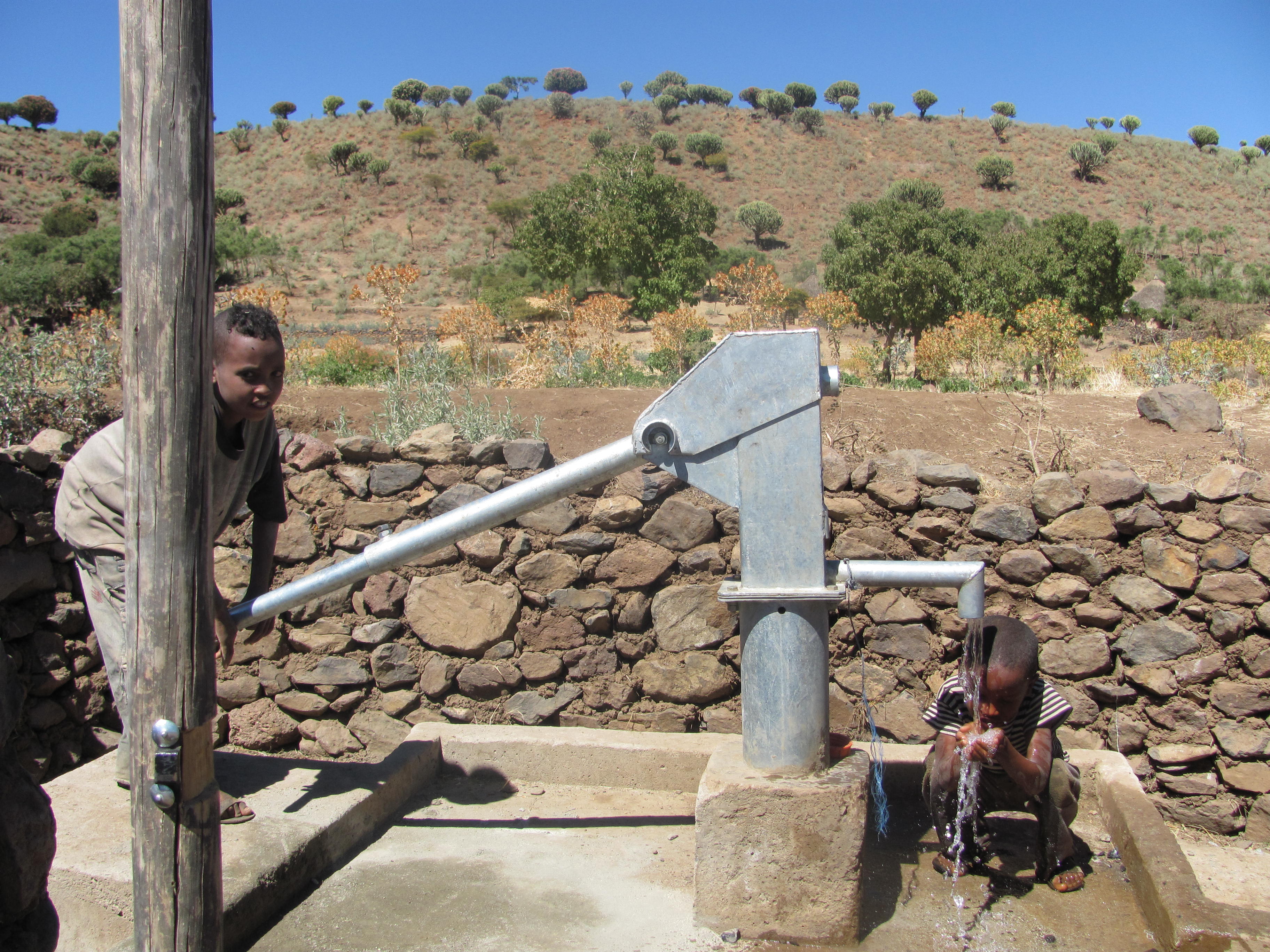
I say all this because that money we raised has built a well in Ethiopia. I just got the email from charity: water. You an look at the Google Map, see the pictures and read about the community impacted by the well.

And there, in the picture, are the words: “In celebration of the adoption of Milo Rahimeto Hendricks.”

"In celebration of the adoption of Milo Rahimeto Hendricks."

I saw those words and started cheering and crying.

You did that.

Thank you.

The Well
The village of Segalu in Northern Ethiopia now has clean drinking water. Before they had to walk up to two hours to collect dirty water. Now clean water is within a 15-minute walk for most of the community. By giving them water, you have given them time and health.

A shallow bore hole was dug and capped with a hand pump. The community build a wall and a door around the well to protect it, taking ownership of it. We’re also working in partnership with the community as each family made a small donation to fund the well (between 3-6 cents) and will pay 3-6 cents per month going forward to fund maintenance.

The well cost a total of $7,244, proving once again that we can’t do it alone. My Addition by Adoption campaign was pooled with two others to collect the necessary funds.

You can read all this on charity: water’s site, but I just love repeating it.

Milo’s Well
I showed Milo the pictures today and told him about the project. I probably said too much—I told him about the book and how it’s about adopting him and clean water and all that. I told him about collecting dirty water in Ethiopia, about giardia and how this well would keep people healthy. I tend to way over-explain these things.

“There it is, Milo,” I said. “There’s a well in Ethiopia with your name on it.”

Then in his little boy voice he said, “Thank you for adopting me.”

His gratitude for being adopted is kind of awkward (would you thank your mom for giving birth to you?). I don’t know what to do with that. It’s not an expectation that should ever be placed on a child. You’re my son. You just are. There’s no thanks required. But he said it, unprompted.

“No Milo, thank you for being my boy,” I said. I hugged him and told him I loved him. That seems like a good response to a great many things in life.

Then he spotted a picture of Lexi on my desk and exclaimed, “There’s Lexi when she was adopted!”

I couldn’t help but laugh. How do I explain that Lexi wasn’t adopted, she was, well, born. Just like Milo was born? But. Wait. Um… Nevermind that the picture was Lexi’s first grade school photo, taken last month.

Confusion abounds, I suppose, but I like that Milo clearly feels safe and loved and knows that “being adopted” is in no way less. It’s just different. And that’s OK. We’re all kind of different.

After all, some of us have wells in Ethiopia with our names on them. And others helped pay for that well. We may be different, but we’re very much the same.

Thank You
I want to say it again: Thank you. While I put my own time and sweat into Addition by Adoption, the numbers above clearly reflect that this didn’t happen because of me. There are at least 80 people who donated to the campaign, others who donated to the campaigns who were pooled together with ours, others who bought books, others who raised funds from their friends and family, and still others who spread the word. To each and every one of you, thank you. I’ll be attempting to send you my personal thanks, but it’s likely I won’t get to everyone (especially the people I don’t even know). So thank you. Thank you.

Milo’s gratitude may have felt awkward for me, but that’s my problem. Let us never shy away from giving thanks. Thank you for helping us help the people of Ethiopia, for giving back to them in a celebration of Milo’s life and heritage. We owe a debt that can never be repaid, but we will try anyway, like drops in the ocean.

Amesege’nallo’.
(‘thank you’ in Amharic)

By the way, Milo’s birthday is next week. What a birthday present.

Voting on Marriage: What If I’m Not Traditional?

Minnesota is in the midst of a political battle over marriage. In less than a month we’ll vote on a constitutional amendment that would define marriage as between one man and one woman, disallowing gay marriage (which is already what Minnesota law says).

I’ve dreaded the debate this amendment would bring. And I’m reluctant to talk about it. It’s very polarizing and a good way to lose some work (I’ve been blacklisted for far less). It’s also a good way to lose some friends. I was more vocal than I should have been in the 2008 election and said some things I regret. Since then political discussions on Facebook often make me cringe (if not shudder). Sometimes I wonder who these people are that I once called friends. I don’t want to come off that way. Hopefully I don’t. If I do, I hope you’ll forgive me and we can talk about it instead of my words making you mad or scaring you away.

However.

This is also an issue that’s hard to be quiet about. This week I came across a Google ad on my site that pointed to the pro-amendment camp. I was curious what kind of advertising they were doing, so I clicked on it and came up with this landing page:

Minnesota for Marriage Google ad landing page (click to view larger)
Minnesota for Marraige Google ad landing page (click to view larger)

What I found makes me very uncomfortable.

There’s no mention of homosexuality or gay marriage at all. Instead they’re advocating for traditional marriage (the typical “we’re not anti-gay, we’re pro-marriage” line). What makes me so uncomfortable is that argument leaves no room for, well, life. I think traditional marriage is great. But it rarely happens. I think kids should have parents—plural. But that doesn’t always happen. I think dads should be involved in their kids’ lives, but to say that marriage is what keeps a father “nearby”? That’s kind of, well, icky.

I think what I find so difficult here is that there’s no attempt made, no caveats, no nod toward life happening. Divorce happens. Death happens. Adoption happens. We’ve got single parents, divorced parents, re-married parents, step parents and adoptive parents. None of them fit very well in this view of traditional marriage as presented by this ad.

Using the word “biological” as a norm is unsettling when you have kids who aren’t biological.

Let’s face it: A lot of families out there are weird. They don’t look very traditional. I think that’s OK. But it’s important that we include these different situations. Inclusiveness is important. It’s harmful to kids to hold up this traditional model as the only way to go and not acknowledge that there are other families who look different, even weird, but that they’re still OK. They’re not defective or somehow less of a family. To do otherwise communicates to an already confused kid that their family is defective, and by extension, they are. This is the crux of diversity training and a driving force in Sesame Street for the last, I don’t know, 40 years.

Maybe what I’m dealing with here is a communication issue. Nothing more. The text is pulled from this page on the campaign site, which gives a little more context.

I hope that’s the case. I hope they’re not being intentionally exclusive. But that’s hard to believe. You don’t spend millions on advertising without being intentional. Especially when you could make the same point with inclusive language.

It’s probably not hard to guess that I’m opposed to the amendment. I guess I could just ignore the messaging of the “other side,” but I guess being a writer I’m curious about why they’re communicating this way.

Turned on the Heat 2012

We finally turned on the heat this morning. We’ve had a pretty erratic fall, going from high 70s and shorts weather to 50s fall weather and then back up to 80s and then down to the 40s. Seems like every weekend has been a different season (so far the pattern has been summer, fall, summer, winter). We went through one morning of it being only 59 degrees in the house, but when it happened again this morning it was time to cave. Plus Lexi, the impervious to the cold child, was complaining. And that’s when the whole ‘how long can we wait before turning on the heat’ game turns into guilt.

In terms of how long we waited, this year was pretty average. Though the internal temp was the lowest in seven years, so that’s something. I guess. (Assuming tracking when you turn on the heat is something.)

Here’s how this year stands up:

Last Chance for The Stephanies

Last month I launched a Kickstarter campaign to publish the book Lexi and I wrote this summer called The Stephanies. In less than three days the project was fully funded.

Awesome.

Over the last month the campaign has hummed along, raising more than double the original goal. That’s pretty cool, especially since extra cash goes toward Lexi’s college fund.

But the Kickstarter campaign comes to an end tonight at 9 p.m. Central. Today is your last chance to join our Kickstarter campaign and support The Stephanies.

But wait, if the campaign is already fully funded, why should I join?
Great question. At this point the goal is met and the project is going forward with or without you. We’re at a fun stage in the life of a Kickstarter campaign where there’s no more hoping and dreaming. The project is a reality and joining up now doesn’t carry any risk that the project might fail.

But two reasons why you might still want to join the campaign:

1) Get the Book Cheap
The Kickstarter campaign will be the cheapest way to get a copy of the book. You can get the digital version for just a buck and the print version for $15 (shipping included, plus a personal thank you from Lexi and me). If you want a copy, now’s the best time to get it. The Stephanies will be on Amazon later, but you won’t be able to get it for as cheap.

2) Cool Rewards
We also have some cool rewards available now. Along with the book, you can also get some cookies, Lexi artwork, join Lexi’s book of the month club or some other fun extras. My personal favorite is the book of the month club. It’s a little pricey at $250, but considering that you get a book shipped to you every month for a year, it’s a pretty great. Today’s your last chance for any of these goodies.

You have until 9 p.m. Central tonight. Ready? Go!

Born to Run

Last week I finished the book Born to Run: A Hidden Tribe, Superathletes and the Greatest Race the World Has Never Seen by Chris McDougall. It’s easily in the top five best books I’ve read this year. And that’s not just because I’ve been doing more running this year than any other year. It’s an incredibly interesting book that makes the most mundane things completely fascinating.

The writer starts off the book with a running injury and wants to know how he can run without getting hurt. His doctors tell him to stop running. It launches into an exploration of running shoes, which didn’t come into use until the late 1960s. The author ends up pursuing a lost tribe in Mexico called the Tarahumara who easily run up to a hundred miles a day in ridiculous canyons with little more than sandals for shoes.

Personally it’s engaging because I’m fighting the same battle. I’ve taken up running recently but I’m terrified I’m going to hurt myself. Something like one in three runners get injured every year. I was going to run a 5K this weekend, but I came back from a run on Thursday with my knees hurting. Pushing it didn’t seem wise. The idea of barefoot running that’s explored in Born to Run suddenly seems appealing.

The fact is that for all our fancy cushioned shoes, running injuries have only increased. Running shoes actually increase the power of your footfall, magnifying potential damage to your feet, ankles and knees. But people have run for millenia without such fancy shoes, so why not do it that way (or at least in minimal shoes—I’m too much of a wimp to go completely barefoot). This barefoot or minimalist trend has skyrocketed recently, to the point that Nike has released their own “barefoot” running shoe. Here’s a good summary from the author’s site.

I’m not sure where I’ll land. I know I need to ease into minimalist shoes if they’re going to work for me, and with my iffy knees right now I need to be especially careful. Exercise shouldn’t be this difficult.

And that’s the most compelling part of this book, that perhaps we’re doing something wrong. Virtually every disease that plagues Western nations can be blamed on poor diet and exercise. Many of our health problems could be solved if we simply went running. We need to re-learn how to run, both to get back into the practice but also to learn how to do it right so we can avoid the epidemic of running injuries.

Which brings me to what I thought was the most fascinating portion of the book. McDougall talked to some evolutionary biologists who theorize that the human body was made to run. This flies in the face of conventional wisdom, which holds that our design is for walking. But as they compared human and animal physiology, they found that we have more traits in common with runners than walkers. As they explored further they found that we’re especially designed to run—but not sprints like a jack rabbit or a cheetah, but long distances. More than any other animal, humans have a capacity to go fast over long distances.

At first this stumped the biologists. How could that be helpful? Long distance is no good if a tiger catches you in the first 10 seconds. Likewise dinner would manage to escape in the first 10 seconds as well.

Then they discovered an ancient art of hunting that involves literally running an animal to death. It’s very rare today with fenced in preserves and what not, but they managed to find a tribe in Africa that would hunt this way: Persistence hunting. They would run an animal down over 20 miles, tracking them, herding them to keep from losing the stragglers and eventually the animals would overheat and die. A deer might be able to outrun you, but if you keep after it, the deer has to slow down to rest and you don’t.

That’s incredible. I’m probably summarizing the story poorly, which is why you should go read the book, but that’s just fascinating. I’d like to see how it goes over with my hunting friends. What if instead of grabbing the rifle or bow, they headed out in shorts and a water bottle, ready to run that buck to death? Think you need a hunting license for that?

Here’s a good video that summarizes the book and includes persistence hunting:

New Book from J.K. Rowling

Five years after the release of the final Harry Potter novel (has it been that long?!), J.K. Rowling is releasing her next book, The Casual Vacancy, today. It’s not a kid’s book, as every review seems to point out with quotes about balls and vaginas (gasp!).

The New Yorker has a lengthy piece about Rowling that’s part bio and part review. It’s fascinating, especially reading about her incredible rise from welfare-recipient to near-billionaire author (almost there: the piece says she’s worth $900 million).

Of course The Casual Vacancy will be a best seller (it’s already #1 on Amazon). But the real question is if it will be any good.

I kind of hope it’s horrible. There’s something encouraging about someone so successful sitting down to dream it all up again and failing miserably. I’m probably not the only one with a bad case of schadenfreude. Though for what it’s worth I’d love to see her come back from a failed comeback (!) with a real winner and put us all to shame.

Of course it’d be that much better if The Casual Vacancy was amazing. Dreaming it all up again worked wonders for U2, delivering us the masterpiece of Achtung Baby. I don’t have those kind of expectations though. I have a hard time imagining Rowling’s voice in anything but a magical children’s novel. But I’ve love to be proved wrong.

Lessons from a Reader: What Now?

I just finished reading the sci-fi thriller Angels of Vengeance by John Birmingham, which is the conclusion of the Without Warning trilogy. The basic premise of the book is that an unexplainable phenomena, dubbed the “wave,” covers a huge swath of North America, instantly killing everyone inside.

How’s that for a premise? Everyone in the continental United States (except for a tiny triangle in Washington which includes Seattle) is instantly gone.

But Birmingham’s trilogy is not about this strange phenomena. In fact, he never explains how the wave came or why, at the end (uh, SPOILER ALERT) of the first book, it inexplicably disappears.

Instead Birmingham’s series is about what happens if you took away the entire population of the United States. Who would fill that vacuum?

It’s not a story about the event. It’s a story about what happens next.

And what happens next is a lot more interesting than whatever sci-fi hocus-pokus you can think up. That’s the lesson for interested writers. Thinking up some incredible event is not the trick. The trick is taking us on the roller-coaster that happens afterward.

I should have realized it, but the same thing happens in Birmingham’s other trilogy, The Axis of Time. An international military force is inexplicably transported to the middle of World War II and accidentally destroys the U.S. Navy (oops). In this case what happens is explained (experiment gone awry), but it doesn’t matter. The story is about what happens next. Not why it happened or how it happened. It’s what now?

That’s perhaps the single greatest question for a writer: What now?

Confederates in the Attic

I’ve never truly understood the Confederate perspective in the Civil War. I’ve blogged about this before, including the Confederate flag, civil rights as an end to the Civil War, some interesting historical perspective and the question of whether or not a state can secede (which still draws comments six years later).

This summer I made my first in-depth trip to the deep South (short stays in Charlotte and Nashville don’t seem to count), spending a week in Oxford, Miss. It was hard to avoid the rebel spirit and I found myself again wondering about this war that divided a nation. I’ve always understood slavery to be the cause and considered this a racist war and continued support for the Confederate cause 150 years later is surely proof of continued racism. But that’s also my Northern perspective, gained from growing up in a state that seemed far removed from Civil War battles (Michigan); living in a state that was barely on its feet when the war started (Minnesota—though for what it’s worth we did volunteer the first regiment, by luck of timing); having roots in a state that served as a flashpoint over slavery and ultimately sided with the North (Kansas); and having never really traveled in the original Confederate states.

In short, it’s a perspective I’ve had very little exposure to over the years.

While browsing in a bookstore in Mississippi I came across Confederates in the Attic: Dispatches from the Unfinished Civil War. It’s a fascinating read that essentially tries to do what I’ve never been able to—understand the fascination and respect that goes along with the defeated Confederate States of America.

A lot of it has to do with the underdog cause, with states rights versus an over-reaching federal government. Some of it is land and loyalty, going along with your people because they’re, well, your people (I’m not sure that’s something we can understand today as few people are as locally fixed as people were back then). And many Southern soldiers weren’t slaveholders—apparently you could be excused from fighting if you owned more than 20 slaves.

“They were poor men fighting a rich man’s war,” says high school teacher Billie Faulk. That seems equally true today.

Historian Shelby Foote offers an interesting defense of the Confederate Flag. It was a battle flag, not the political flag, and veterans revered it as soldiers do. It became associated with hatred during the civil rights era when educated Southerns allowed white supremacists to misuse the flag. “That’s when right-thinking people should have stepped in and said, ‘Don’t use that banner, that’s not what it stands for.’ But they didn’t. So now it’s a symbol of evil to a great many people.”

That’s where the shift gets interesting. There’s this on-going animosity in the South, which I suppose is to be expected of a conquered people. After the Civil War they didn’t celebrate the Fourth of July in Mississippi again until 1945. In Richmond, the Confederate capitol, there’s Monument Avenue, which is effectively a shrine to the defeated leaders of the Confederacy (except for black tennis star Arthur Ashe, added in the late 1990s with its share of controversy). How odd is it to have monuments to what amounts to insurrectionists and traitors? And Richmond certainly isn’t alone. Confederate monuments are sprinkled across the South (Vicksburg, Miss., is apparently home to more than 1,300 plaques and monuments).

That’s what is perhaps most surprising about the Civil War. For four years brother fought against brother, but when it was over we became one nation again. Reconstruction wasn’t exactly pretty (which is why I’m even writing this today), but that it happened at all was amazing. Most Confederate leaders were never tried (only two Confederates were brought up on war crimes, commander of the Andersonville prisoner camp Henry Wirz and guerrilla fighter Champ Ferguson). Even Confederate President Jefferson Davis was released after two years in prison and no charges were brought against him. The Confederacy was not labeled as an insurrection and all supporters branded traitors.

In the end I’m not sure if I’ve made any ground. At the very least, I’ve come to understand the whole situation as being incredibly complicated. I do think its disingenuous when Confederate supporters and rebel flag flyers dismiss slavery as part of the issue. It’s part of what makes America uniquely, well, American (and how American is it to talk about how unique we are?). We were founded in the contradiction that all men are created equal, except for the slaves and Indians, maybe those Jews and immigrants we don’t like, and oh yeah, the Irish. We eventually went to war with ourselves over it and came out united. Of course freeing the slaves didn’t exactly fulfill the promise that all men were created equal and it was another hundred years before that was carried out.

Even today we continue to live with the contradiction. Though we’re past slavery and segregation, we still have racism and self-imposed segregation. Though equality isn’t exactly there, the fact that we finally have a black man as president shows how far we’ve come. That he opted to hang a copy of the Emancipation Proclamation in the halls of the White House is powerful (the fact that no president did that before shows how blind we can be to the power of our own history).

I don’t know where I’m going with any of this, but it’s an interesting history to wade through.

Let’s Publish the Stephanies

This summer Lexi and I wrote a children’s book called The Stephanies. Lexi drew the pictures and we want to publish it. We need your help.

The Stephanies is a short, goofy little story about two girls who are both named Stephanie. Sharing a name causes all kinds of problems and the two girls continually square off:

“My name is Stephanie!”

“No, my name is Stephanie!”

“Grr…” both girls grumbled.

It’s great fun. If you’re into children’s books, think more Robert Munsch than Margaret Wise Brown.

Tonight we launched a Kickstarter campaign to make the book a reality.

What’s a Kickstarter?
Good question. Kickstarter is awesome. It’s a site that allows creators to go straight to their fans to raise support for their projects. Creators come up with a fundraising goal and a deadline. If they can raise the money before the deadline, people pay up and the project goes forward. If the goal isn’t met by the deadline, everybody keeps their money and the project doesn’t happen (You may remember that I tried a failed Kickstarter project back in 2010—we didn’t meet the goal, so all those great backers kept their money). Creators also come up with rewards to encourage people to support their project, like a copy of whatever is created, behind-the-scenes access, limited edition items and more.

It’s an exciting development for creators and fans alike. Last year Kickstarter brought one of my favorite bands, Five Iron Frenzy, back from the dead. It allowed indie artist Shaun Groves to fund a new record without a label. It enabled a sequel when a publisher balked. Just last week it funded the new Molly Danger comic book from Jamal Igle. And it’s two-thirds of the way toward funding a new book and album project for Justin McRoberts. And those are just a few of the projects I’ve supported. It’s for plenty of other awesome ideas as well, like smarter consumer electronics (they’ve already raised over half a million dollars!), an ad-free future for the comic Penny Arcade, and even a space elevator.

It’s great fun to become a patron of what you think is cool.

Back to The Stephanies
So yeah, we’ve launched a Kickstarter campaign to get The Stephanies published. We’re trying to raise a modest $300 by Oct. 3 to help defray the time and effort of publishing the book. We’re going to do three versions—digital, “color your own,” and full-color paperback. Back the project at any amount and you get a copy of the book ($1 for digital, $10 for “color your own,” and $15 for paperback, shipping included). Pony up $25 and you get all three versions, plus Lexi will create some custom artwork for you. We’ve got some higher end rewards for the big spenders, including a cookie package, Lexi’s book of the month club and your very own custom book written by Lexi and I.

Lexi helped me every step of the way on this project, including coming up with the rewards. She didn’t think anyone would pay a lot of money for this project, so we tried to keep all the reward prices as low as possible. By backing the project you’re getting the family discount. This isn’t about making money, it’s about sharing our story.

The Stephanies has been a fun summer project for Lexi and I. We’d love to turn it into a real book and share it with the world. We hope you’ll help.

A work-at-home dad wrestles with faith, social justice & story.