It’s Your Actions, Not Your Beliefs

Came across a great little blog post by Shawn Smucker. Who? I don’t know, but multiple people were linking to the post so I checked it out. Glad I did.

He argues that beliefs have become the litmus test of our culture. A week and a half before an election, that’s too true.

And it’s especially true for the church:

Taking the “correct” position on every issue imaginable has become our way of declaring the Good News. It’s no wonder church attendance is dwindling and the broader culture is becoming increasingly disenchanted with Christianity – when the message of Good News has been watered down to consenting to various positions or beliefs, the Good News transforms into the Right News. Which is actually rather annoying, and not much fun to listen to or to help spread.

So true. Any time we line up based on our beliefs it gets ugly. But when we’re able to look beyond our beliefs, we can come together and accomplish so much more (hmm… that’s sounds like the core idea of Anglicanism, maybe part of why I like my church).

The solution Shawn advocates: Action, not belief. It’s about loving people, not believing the right thing.

I think smart people would say this is the debate between orthodoxy (right belief) and orthopraxy (right action). They’d also probably argue that you can’t have right action without right belief—otherwise how do you know what to do? I get that, but I think it’s a facade. You don’t have to nail down every belief to know how to love people.

Shawn ends with a painful question: “Are we Christians good for anything anymore?”

How we answer that—or rather, how the rest of the world (family, friends, strangers) answers that is the ultimate test.

Sidebar: I realize letting the rest of the world answer that seems like a reversal of the Christian position. Shouldn’t our worth come from God? Yes. However, if we’re supposed to love our neighbor then that love should play a major role in answering that question. If we’re not good for anything, we’re doing it wrong. Let’s confess and try again.

Billy Graham Gets Political

A story broke last week that the Billy Graham Evangelistic Association (where I worked about a decade ago) had removed mentions of Mormonism as a cult from its website following a meeting between the 93-year-old Billy Graham and Republican presidential candidate (and Mormon) Mitt Romney. Then a spokesman said they did it because “we do not wish to participate in a theological debate about something that has become politicized during this campaign.” Uh, I think you just politicized it.

If you’re a Christian and you want to vote for Mitt Romney, go for it. But don’t suddenly change your views on Mormonism and say it’s not political. Not three weeks before the election. Can we at least be honest enough to admit this is politically motivated? And for what? Who’s going to change their vote over this? (Maybe people will vote the other way!)

It’s basic communication. And it’s why I’m plenty busy at Church Marketing Sucks (and now my long quiet Billy Graham blog, Billyspot).

Let me be clear: I don’t think Mormonism is a cult. It’s probably a good change the BGEA made. But the timing is just horrible. And the explanation is ridiculous. It seems unfair to call a religion of 14 million people a cult. That’s a loaded term and it has no place in the kind of loving outreach that’s defined Billy Graham’s ministry. Though we should also be clear that Mormonism is not Christianity.

Let me also say: I don’t think it should matter. The fact that we have to ask whether or not a Christian can vote for a Mormon is kind of disturbing. As Franklin Graham says, “Americans must remember that while our nation was founded upon godly principles, we do not have a state religion.” Of course then he goes on to say, “We need something like what Jerry Falwell did in the 1980s. We need a ‘moral majority'” Sigh.

Apparently evangelicals like Graham (Which one? Good question: Christianity Today explores Billy Graham’s recent politicism and Steve Knight wonders if Franklin is speaking for his father) will choose politics over theology when it works for them. All so they can somehow wiggle around the language and support a candidate who supports “God’s principles.” Never mind that it’s a rather different view of God. But not too different… we’re not supporting Muslims. Or atheists. Egads, no!

Meanwhile my generation has grown tired of religion constantly warring with politics. We’ve recognized that in the pluralistic society we’ve grown up in, it’s OK to work with, befriend, even vote for somebody who is different than you. And most of us don’t need to scrub our websites or write editorials to do so.

What Do Political Yard Signs Accomplish?

Are pint-size political billboards worth the paper they’re printed on? I’m thinking no.

“I love watching people waste their money on signs. It’s great. Keep spending your money that way. What do you learn from a sign? What does a sign tell you?” Democratic consultant Judy Stern says in a Sun Sentinel story. “Signs don’t vote.”

But popular wisdom says that name recognition, especially in local races, is valuable. When you’re voting for a bunch of folks you’ve never heard of for city council, it helps if you’ve seen one candidate’s name around town.

“You don’t even really think about it,” says Marietta College psychology professor Mark Sibicky in The Plain Dealer. “It’s a classically conditioned response. All things being equal, we like the familiar name.”

Another report backs up the name recognition theory and suggests it also has more to do with the person putting up the sign. They say each sign is worth 6-10 votes, not because of the sign, but because the person putting up the sign is likely to encourage votes in other ways.

But knowing who’s running doesn’t help you make an informed decision. In national elections that name recognition is kind of useless. No one puts a Romney sign in their yard to make sure their neighbors have heard of him.

It seems like the problem is that political yard signs generally don’t communicate a message. It’s simply a name. All they’re getting is awareness. It doesn’t communicate your reasons for voting. It doesn’t contain any message that could persuade other voters. It’s merely a badge of pride, a flag of identification, letting people know where you stand. At best, it gives people the illusion of popularity (“There are bunch of Joe Jones sign in my neighborhood, I bet he’s going to win!”).

That works for U.S. Representative Dennis Kucinich: “This is better than a paid billboard, because it’s a personal endorsement. It shows that I have support at the neighborhood level.”

I wonder why candidates don’t put any slogans or messages on their yard signs? I’ll admit you couldn’t fit much of a message on any yard sign and it’d come down to bumper sticker slogans, which might not be any better (why don’t campaign bumper stickers have, um, bumper sticker slogans?). But wouldn’t that at least communicate something? According to the experts, that’s a rookie mistake. According to sign printer Dale Fellows in The Plain Dealer, political signs should feature the candidate’s name as big as possible. The fewer words the better.

Bah. I wish signs actually communicated something.

On the plus side, it’s likely they’re not a decisive factor: “Well, I think that it would be very unusual if any of these tactics actually were decisive in elections,” says Costas Panagopoulos, professor of political science at Fordham University in an NPR story. Well, not usually: “But at the margins, mobilizing voters can be very important. And particularly in close, competitive races, they can make a difference in determining the outcome of an election.”

I guess election marketing just sucks.

What Do You Want for Christmas?

Wrapping RexSeriously? It’s not even Halloween yet and I’m asking about Christmas?

I know. Sorry. With family spread across the country we generally do at least three different Christmas gift exchanges between Thanksgiving and Christmas. Needing to have gifts by Thanksgiving can sneak up on you. So I need to have a Christmas list early.

And I suck at Christmas lists.

I like to rebel and not do one, but then poor grandmas throw up their arms and have to resort to gift cards, which they hate.

Then I get too practical. Do I really need all the usual crap? Then my list amounts to six items nobody wants to buy (two of which were gift cards). One year I told my wife I needed socks. I think she hit me. Trying to be anti-materialistic isn’t compatible with the Christmas list. I guess that’s the point—this is stuff I wouldn’t buy for myself. They’re gifts. They’re supposed to be extravagant.

Last year I got smart and told my wife I wanted a new winter coat. Half the present was her doing the shopping and making the decisions for me. Best. Present. Ever.

So materialism aside, I’m trying to fill out my Amazon wishlist and for once I have more than six boring things. I have a lot of ridiculous things nobody will buy (Like $150 prints, a new TV and $200 Lego sets—see? Extravagant.) as well as some realistic stuff like the new Anne Lamott book, picture frames (hey, something besides books & movies!) and a Blu-ray player.

So what do you want for Christmas this year? Help me out, I can pad my list by stealing your ideas!

Reframing the Story of Ethiopia

The usual story we hear about Ethiopia is one steeped in poverty and despair. We hear stories of famine and political unrest. That’s the common narrative. It’s unfortunate because stories are powerful. But it’s not the whole story.

There are also Ethiopians doing amazing things. Not just marathon runners, but business leaders, doctors, activists, writers, musicians and more. Flowers of Today, Seeds of Tomorrow is a coffee table book to tell those stories. They’re currently doing a Kickstarter project to fund publishing the book. It’s about 85 percent written, and you can see some of the incredible stories and layouts on the Kickstarter page.

This is an opportunity to reframe the story of Ethiopia.

Doing Good in Ethiopia
I don’t want to contribute to the narrative of despair. I’m wary of providing the kind of international aid that’s merely drops of water on a wildfire. While famine, poverty and despair need to be stopped, I want to address those issues in ways that offer hope and empowerment, not empty charity.

Just last week we celebrated a new well in Ethiopia. I love that the local people in Segalu built their own wall around that well to protect it and are raising their own money to support and maintain that well. I hope this is a project that empowers them, freeing up their time and energy to pursue more productive efforts.

Likewise, I think Flowers of Today, Seeds of Tomorrow is a book that can empower a people. It reframes their story and shifts the focus from nostalgia for the past or despair for the failures of today to a hope in the promise of tomorrow. These are stories of Ethiopian heroes who have overcome that past to find success today.

We need those stories. We need those heroes.

Bring It Home
Four years ago today my son Milo was born in Ethiopia. I wouldn’t see his picture for six weeks and I wouldn’t hold him in my arms for five months. He no longer lives in Ethiopia, but it will always be a part of him, a part of me. These are his stories, and as you can imagine, I have a vested interested in seeing stories of hope and not despair.

Ethiopians, like all of us, are not bound by poverty and famine. They are not limited to political unrest. They have heroes and champions. It’s time for a book that tells those stories. I know my family needs one in our library.

Consider backing this Kickstarter campaign and helping this project come to life. I know it’s a lot of money, but the $50 reward gets you a hardcover version of the book and they’ll donate two softcover Amharic versions to libraries in Ethiopia through Ethiopia Reads. That’s a great way to share these stories with your family and with the people of Ethiopia.

Let’s tell the story of hope.

Why I Like My Church

Buddy KevinI was having a conversation with a new couple at church yesterday and the inevitable question came up: How long have you been attending Messiah? It’s been 11 years now.

That’s insane. Nobody my age commits to anything (much less a church) for that long. I’m already part of the old-guard. I remember the previous rector (that’s Episcopalian for pastor). I remember what the building was like before the addition. I’ve earned the right to protest, “But that’s how we’ve always done it!”

That conversation made me think about why we’ve stuck it out at Messiah for so long.

Relationships
Much of it has to do with the people. Some smart folks say that friendships are what keep people in church, and I’m inclined to agree. We tried to fit in at our previous church, tried to move beyond being college students to being regulars, but it never quite took. When we taught Sunday School and the parents didn’t know our names we decided it was time to move on.

But we found those relationships at Messiah. It helped that there were plenty of social dinners organized where you were encouraged to get to know people. I remember several rounds of dinners like that at various people’s houses that slowly pulled us in. It also helped when we were invited over for dinner on Easter Sunday. Who invites people over for dinner on Easter Sunday at the last minute? Really nice people, that’s who. People who understand a young married couple with no family in town.

Diversity
The other thing I like about my church is the diversity. Now I’ll be honest: We’re mostly a bunch of white folks. We don’t quite have the racial diversity. But that’s changing (it’s much more prevalent at the earlier service with an explosion of KaRen). But we do have other diversity. There’s a huge mix of ages (110 kids in 5th grade or under, in a church of 300!) and styles. On Sunday morning you’re sure to hear both an organ and an electric guitar. You’ll also see someone in jeans, a T-shirt and sandals next to someone in a suit and tie.

All that diversity in and of itself doesn’t mean a lot. But it does tell me that the people are able to value what’s different and get along despite disagreements. Nobody is up in arms over the drums or the 18th century hymns, demanding we change to suit their needs. That sounds ridiculous, but I grew up in atmosphere where it was common.

Liturgy
Finally, I was drawn to the liturgy. Growing up in an independent church less than 40 years old, there was no sense of history. There was no connection to the wider faith that went all the way back to Christ. We were somehow disconnected and adrift, which was painfully obvious anytime a pastor left. At Messiah, I was shocked when the rector left without any controversy.

But the liturgy, those words repeated by Christians all over the world and throughout time, well, you can’t avoid that connection. It’s deep. It’s powerful. There’s a danger of it becoming too familiar, but I’ll gladly take that danger than the disconnected prattling of someone in a suit trying their best to sound spiritual and only accomplishing saying ‘Lord’ and ‘Jesus’ every few words.


I could go on. Everybody has their own reasons for sticking with a church, moving on, or giving up. But those are the ones that came to mind when I reflected on why I’ve been here for over a decade.

What about you? Why do you like your church?

The Royal Ethiopian Regiment

I just finished reading The Astonishing Life of Octavian Nothing, Traitor to the Nation, Volume II: The Kingdom on the Waves by M.T. Anderson. If the length of the title is any indication as to the length of the prose, be warned. At 550+ pages of 18th century writing by a classically trained slave, this book is a chore to read. It doesn’t help that very little happens. Which is all too bad. It’s a fascinating story of an escaped slave joining up with the British to become part of the Royal Ethiopian Regiment to fight the revolting Colonials.

I was curious about this Royal Ethiopian Regiment, though it probably had few if any actual Ethiopians in it. While the story is fiction, it’s based on fact. Lord Dunmore, governor of Virginia, issued a proclamation that any slaves escaped from rebels would be granted freedom for serving in the British Army. Some 800 were organized into the Royal Ethiopian Regiment, though they were never given much of a chance to fight. They were led into a trap at the Battle of Great Bridge and were later decimated by smallpox. Only 300 of the original 800 survived the eventual retreat to New York.

The story of black Loyalists in the American Revolution is interesting. The title of the book paints Octavian as a traitor, but what choice did he have? Traitor, slave, dead. Black Colonials had no hope of freedom, while the British often offered freedom as a way to encourage recruits and disrupt the colonists. Those promises were eventually honored and some of these black Loyalists were moved to Nova Scotia and later Sierra Leone.

There’s an interesting author’s note at the end of The Kingdom on the Waves that reads in part:

In the course of my research for this book, I have come to believe that the American Republic would not have survived its early years—would not have made it through the War of 1812—if it had not been fueled and funded by two profound acts of ethnic violence: the establishment of slavery and the annexation of Native American lands, both of which practices played a major part in the inception and conduct of the Revolution. The freedom—economic, social and intellectual—enjoyed by the vocal and literate elite of the early Republic would have been impossible if it had not been for the enslavement, displacement and destruction of others.

With so much whitewashed talk of our founding fathers, that’s perhaps a more realistic look. But they’re not alone in their guilt:

But it is easy to condemn the dead for their mistakes. Hindsight is cheap, and the dead can’t argue. It is harder to examine our own actions and to ask what abuses we commit, what conspicuous cruelties we allow to afford our luxuries, which of our deeds will be condemned by our children’s children when they look back upon us. We, too, are making decisions. We, too, have our hypocrisies, our systems of shame.

Milo’s Well

In 2010 I wrote the book Addition by Adoption. It’s a collection of tweets and essays that tells the story of my son coming home. It’s a story of adoption, clean water and a stay at home dad. I wanted it to be more than just a book, so we pledged to build a clean water well in Ethiopia. Wells cost an average of $5,000, so we had a lot of work to do.

A little over two years ago we met that goal and raised $5,000. Sales of the book (usually $2 from every copy, in some cases more) generated $628, and the incredible generosity of so many people raised the rest—$4,385. It’s yet another reminder that we can do so little on our own, but we can do more than we can imagine together.

I say all this because that money we raised has built a well in Ethiopia. I just got the email from charity: water. You an look at the Google Map, see the pictures and read about the community impacted by the well.

And there, in the picture, are the words: “In celebration of the adoption of Milo Rahimeto Hendricks.”

"In celebration of the adoption of Milo Rahimeto Hendricks."

I saw those words and started cheering and crying.

You did that.

Thank you.

The Well
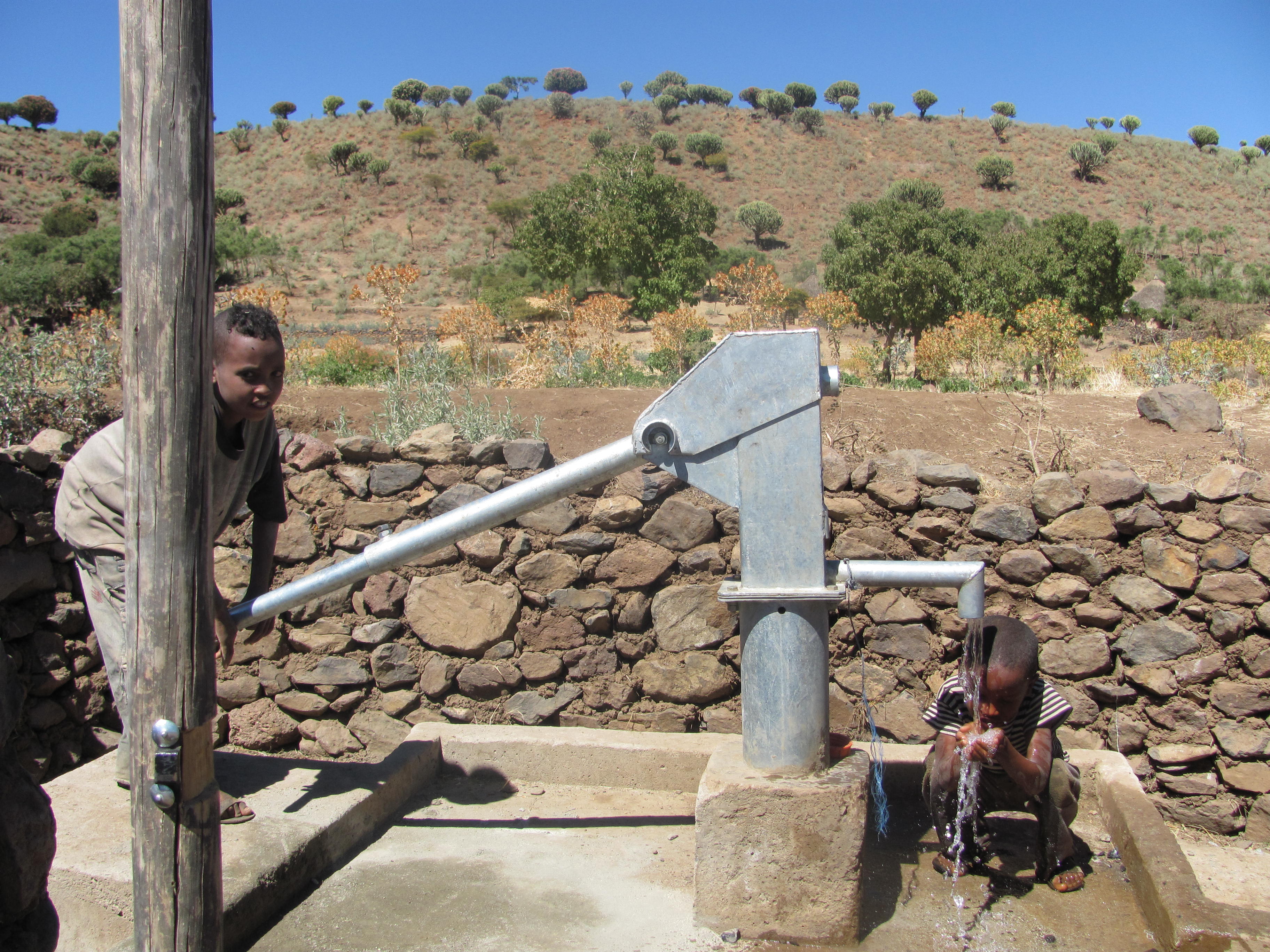
The village of Segalu in Northern Ethiopia now has clean drinking water. Before they had to walk up to two hours to collect dirty water. Now clean water is within a 15-minute walk for most of the community. By giving them water, you have given them time and health.

A shallow bore hole was dug and capped with a hand pump. The community build a wall and a door around the well to protect it, taking ownership of it. We’re also working in partnership with the community as each family made a small donation to fund the well (between 3-6 cents) and will pay 3-6 cents per month going forward to fund maintenance.

The well cost a total of $7,244, proving once again that we can’t do it alone. My Addition by Adoption campaign was pooled with two others to collect the necessary funds.

You can read all this on charity: water’s site, but I just love repeating it.

Milo’s Well
I showed Milo the pictures today and told him about the project. I probably said too much—I told him about the book and how it’s about adopting him and clean water and all that. I told him about collecting dirty water in Ethiopia, about giardia and how this well would keep people healthy. I tend to way over-explain these things.

“There it is, Milo,” I said. “There’s a well in Ethiopia with your name on it.”

Then in his little boy voice he said, “Thank you for adopting me.”

His gratitude for being adopted is kind of awkward (would you thank your mom for giving birth to you?). I don’t know what to do with that. It’s not an expectation that should ever be placed on a child. You’re my son. You just are. There’s no thanks required. But he said it, unprompted.

“No Milo, thank you for being my boy,” I said. I hugged him and told him I loved him. That seems like a good response to a great many things in life.

Then he spotted a picture of Lexi on my desk and exclaimed, “There’s Lexi when she was adopted!”

I couldn’t help but laugh. How do I explain that Lexi wasn’t adopted, she was, well, born. Just like Milo was born? But. Wait. Um… Nevermind that the picture was Lexi’s first grade school photo, taken last month.

Confusion abounds, I suppose, but I like that Milo clearly feels safe and loved and knows that “being adopted” is in no way less. It’s just different. And that’s OK. We’re all kind of different.

After all, some of us have wells in Ethiopia with our names on them. And others helped pay for that well. We may be different, but we’re very much the same.

Thank You
I want to say it again: Thank you. While I put my own time and sweat into Addition by Adoption, the numbers above clearly reflect that this didn’t happen because of me. There are at least 80 people who donated to the campaign, others who donated to the campaigns who were pooled together with ours, others who bought books, others who raised funds from their friends and family, and still others who spread the word. To each and every one of you, thank you. I’ll be attempting to send you my personal thanks, but it’s likely I won’t get to everyone (especially the people I don’t even know). So thank you. Thank you.

Milo’s gratitude may have felt awkward for me, but that’s my problem. Let us never shy away from giving thanks. Thank you for helping us help the people of Ethiopia, for giving back to them in a celebration of Milo’s life and heritage. We owe a debt that can never be repaid, but we will try anyway, like drops in the ocean.

Amesege’nallo’.
(‘thank you’ in Amharic)

By the way, Milo’s birthday is next week. What a birthday present.

Voting on Marriage: What If I’m Not Traditional?

Minnesota is in the midst of a political battle over marriage. In less than a month we’ll vote on a constitutional amendment that would define marriage as between one man and one woman, disallowing gay marriage (which is already what Minnesota law says).

I’ve dreaded the debate this amendment would bring. And I’m reluctant to talk about it. It’s very polarizing and a good way to lose some work (I’ve been blacklisted for far less). It’s also a good way to lose some friends. I was more vocal than I should have been in the 2008 election and said some things I regret. Since then political discussions on Facebook often make me cringe (if not shudder). Sometimes I wonder who these people are that I once called friends. I don’t want to come off that way. Hopefully I don’t. If I do, I hope you’ll forgive me and we can talk about it instead of my words making you mad or scaring you away.

However.

This is also an issue that’s hard to be quiet about. This week I came across a Google ad on my site that pointed to the pro-amendment camp. I was curious what kind of advertising they were doing, so I clicked on it and came up with this landing page:

Minnesota for Marriage Google ad landing page (click to view larger)
Minnesota for Marraige Google ad landing page (click to view larger)

What I found makes me very uncomfortable.

There’s no mention of homosexuality or gay marriage at all. Instead they’re advocating for traditional marriage (the typical “we’re not anti-gay, we’re pro-marriage” line). What makes me so uncomfortable is that argument leaves no room for, well, life. I think traditional marriage is great. But it rarely happens. I think kids should have parents—plural. But that doesn’t always happen. I think dads should be involved in their kids’ lives, but to say that marriage is what keeps a father “nearby”? That’s kind of, well, icky.

I think what I find so difficult here is that there’s no attempt made, no caveats, no nod toward life happening. Divorce happens. Death happens. Adoption happens. We’ve got single parents, divorced parents, re-married parents, step parents and adoptive parents. None of them fit very well in this view of traditional marriage as presented by this ad.

Using the word “biological” as a norm is unsettling when you have kids who aren’t biological.

Let’s face it: A lot of families out there are weird. They don’t look very traditional. I think that’s OK. But it’s important that we include these different situations. Inclusiveness is important. It’s harmful to kids to hold up this traditional model as the only way to go and not acknowledge that there are other families who look different, even weird, but that they’re still OK. They’re not defective or somehow less of a family. To do otherwise communicates to an already confused kid that their family is defective, and by extension, they are. This is the crux of diversity training and a driving force in Sesame Street for the last, I don’t know, 40 years.

Maybe what I’m dealing with here is a communication issue. Nothing more. The text is pulled from this page on the campaign site, which gives a little more context.

I hope that’s the case. I hope they’re not being intentionally exclusive. But that’s hard to believe. You don’t spend millions on advertising without being intentional. Especially when you could make the same point with inclusive language.

It’s probably not hard to guess that I’m opposed to the amendment. I guess I could just ignore the messaging of the “other side,” but I guess being a writer I’m curious about why they’re communicating this way.

Turned on the Heat 2012

We finally turned on the heat this morning. We’ve had a pretty erratic fall, going from high 70s and shorts weather to 50s fall weather and then back up to 80s and then down to the 40s. Seems like every weekend has been a different season (so far the pattern has been summer, fall, summer, winter). We went through one morning of it being only 59 degrees in the house, but when it happened again this morning it was time to cave. Plus Lexi, the impervious to the cold child, was complaining. And that’s when the whole ‘how long can we wait before turning on the heat’ game turns into guilt.

In terms of how long we waited, this year was pretty average. Though the internal temp was the lowest in seven years, so that’s something. I guess. (Assuming tracking when you turn on the heat is something.)

Here’s how this year stands up: