Category Archives: Society

Adoption and Abortion

If the practice of abortion ended the world would have to deal with 42 million unwanted children every year. How can anti-abortion advocates respond to that when there are already 148 million orphans in the world? How can we ask for more unwanted children when we’re not taking care of the already orphaned children in the world?

I ask this question not to defend abortion. I don’t like abortion. The numbers are staggering—42 million abortions worldwide every year? That’s nearly as high as the annual worldwide death rate (approximately 56 million people die ever year).

I ask this question because I don’t think anti-abortion advocates focus enough on solutions. Adoption is one solution, and while churches and Christians are very supportive of adoption (I should know), they’re not supportive enough (to the tune of 148 million children without families).

For many Christians, adoption is a “good thing.” It’s a good deed you did and we’ll applaud you for it, but it’s not a normal practice. It’s what you do when you can’t have kids. It’s what you do when you’ve already had a few kids “of your own.” But it’s rarely a first choice. It’s rarely promoted as something all families should consider (I was ecstatic to see Rick Warren talking about promoting adoption in his church).

I know adoption isn’t for everyone. There are inherent challenges and if you’re not prepared you have no business adopting. But it just seems inconsistent to me that Christians are so against abortion but don’t seem truly prepared to end abortion.

When a pregnant mother considers abortion, would you step forward to adopt her baby? And why would she believe that you’d adopt her baby when she sees the 148 million orphans we haven’t adopted?

Abortion is a difficult issue and I hate talking about it because it’s so divisive. But this question has been nagging at me for a while. Why isn’t adoption standard practice in the church? It’s definitely supported and encouraged when it happens, and I’d wager that it’s more widespread in the church, but it’s still far from the norm. If adoption were the norm it would change the abortion debate. For that matter if adoption were the norm it would change the world.
Dependence Day

Today we celebrate our independence.

But our strength is in our dependence.

We depend on one another. We depend on our armed forces to keep us safe. We depend on family and friends for love, sanity and good times. We depend on employers and clients and customers for our paychecks and livelihood.

The loner is the great American archetype. Personal freedom, personal responsibility, personal choice seems to be our national mantra. It’s so often about me, myself and I. The consumerism that drives our capitalism is all about self.

But independence was only achieved by depending on one another. Freedom is not about selfish gain but what we can have and achieve together. Right now Iranians are flexing their democratic muscle by relying on one another. No man is an island.

Continue reading Dependence Day

The World is Too Complicated

Some days I’m convinced the world is too complicated. The past week is a good example:

  • People mourning the undisputed King of Pop, who for the last 15 years or so traded in that crown for the King of Weird. Musical brilliance and creepiness combined. That’s complicated.
  • The ongoing crisis in Iran. Bottom line: freedom and democracy good, bloodshed bad. Beyond that, I’m lost trying to understand the political ins and outs.
  • Then there’s Honduras. Did you hear they had a military coup this weekend? The funny part is listening to people argue why one side is legal and the other illegal. I swear if you switch the names it’s the same argument.
  • And let’s not talk about the time I tried to explain Twitter to a friend at a party.

For all the complication and confusion and head-scratching, I’m glad that some things are simple:

  • Like water.
  • Like the importance of having a place to live.
  • Like adoption. OK, there’s not much that’s simple about adoption, but kids should have families. Who can argue with that?

For all the complication in the world, sometimes we need a little simplicity.

Never Before Have So Many Been Able To Do So Much

I love reading indie-folk rocker and Compassion-plugger Shaun Groves’ blog. Because every time it kicks me in the butt. That’s probably why I don’t read it very often (sorry Shaun). Today was no different. A post about how insignificant we are in the grand scheme of things.

Shaun gave us a reminder that today we are directly responsible for very few of our basic needs. Providing food, shelter and clothing is pretty easy. You don’t have to toil in a field all year to get your food. We don’t spend every morning gathering food for the day. As Shaun said:

At no other time in history have other people been so capable of meeting my needs for me. Strangers are doing all my life-alteringly significant chores and leaving me with nothing to do but wake up every day and simply ask “What do I want to do?”

You and I have more time than anyone has ever had.  More education.  More money too.  So now what?  What will today be about?

Continue reading Never Before Have So Many Been Able To Do So Much

The Crusades Were a Bad Idea: Let’s Not Do It Again

Update: I’ve been Snoped. Ouch. It appears the stats in this video are of questionable accuracy. They’re not denied outright, but there are significant questions. Despite all the rhetoric (my own included), perhaps the real question this post should raise is how should we respond to news of the growing population of a different faith? I’d contend that the negative overtones of this video aren’t helpful. End update.

I saw what I consider to be a bat-crazy video today. Take a look and tell me what you think:

Continue reading The Crusades Were a Bad Idea: Let’s Not Do It Again

Race in the Obama Era

I came across two interesting stories last week involving race (apparently today is blog about stuff I found last week day).

The first is a Newsweek article about a black family that adopted a white girl. It’s an interesting story and sad that multi-racial adoption seems to only be accepted one way.

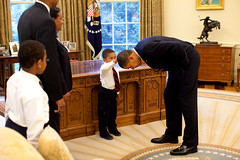
The second is this photograph of a young black boy and U.S. President Barack Obama. The boy asked to touch Obama’s hair to see if it really felt the same as his. It’s another reminder that children don’t see race the same way adults do.

Just Help

Last week I came across an interesting web site, Photos that Changed the World (thanks to kottke.org). Among the photos that grabbed me (c’mon, they’re photos that changed the world, they almost all grabbed me) was this one of a Sudanese child suffering from starvation while a vulture looks on in 1993:

The photograph won the Pulitzer prize. The photographer, Kevin Carter, later committed suicide (while the fame and controversy of this photo may have contributed to his death, it seems more complex than that). While the ethical questions of this photograph are important and complicated, that’s not what interests me.

What I found so intriguing about this photo is that it’s simply a little girl starving to death. When it comes down to it, something so incredibly simple and basic is killing her. The reasons for that suffering are much more complex, but in the end it’s pretty basic. She needs food and water. As damning as the photo is and as complex as the entire situation may be (are civil wars ever simple?), in the end it’s pretty simple.

That’s part of why I’m asking for water for my birthday. It’s staggering that something as simple as not having clean water is killing people. 4,500 children every day, to be exact. That’s a stupid reason to die. And as complex as the reasons may be for why these people don’t have clean water, the reason to act is pretty simple.

Water=life. That’s a pretty simple cause when you get down to it. There aren’t many people who will argue and protest the idea of giving starving people food or thirsty people clean water. Clean water is kind of a no-brainer. We may not agree on everything, but I’m hoping clean water is something everyone can agree on.

And if that’s all a little too heavy for you, perhaps a photo site of a completely different magnitude: Awkward Family Photos (thanks to Jason Boyett).

1.2 Million Child Prostitutes in India

There are believed to be 1.2 million children in India trapped in prostitution and sexual exploitation. Those kinds of numbers are just sad. Human trafficking is one of the injustices in the world today that makes your heart ache. How could something like this be happening? How could one person do this to another? Apparently 100 million people in India are involved in doing this to other people. Ouch.

And if you think that’s a problem for halfway around the world, human trafficking is in your own backyard. In 2007 authorities busted eight human trafficking brothels across the Twin Cities. One bust happened less than a mile from my house.

You can fight human trafficking by supporting organizations like the International Justice Mission. As sad as these stories are, they don’t have to be the final word.

What’s a Necessity?

Interesting article exploring a Pew Research Center study about what Americans consider necessary. A car is at the top of this year’s list, followed by a clothes dryer (not a washing machine? Survey FAIL?), air conditioning, TV and a computer. It’s kind of an interesting study, especially since things have become a little less necessary since 2006.

I found a few things surprising:

  • People consider cable or satellite TV more necessary than a dishwasher. Seriously? Without a dishwasher how do you have time to watch all that TV?
  • Older people are much more likely to think a TV is necessary than younger people. So TV isn’t rotting our brains—in your face, old people! Of course younger people are much more likely to think cell phones are a necessity.
  • The richer you are the less likely you are to think TV is a necessity—until you hit the low end of the poverty scale where TV becomes less necessary. The same is true for a veggie garden. The very rich and the very poor don’t have time for TV or planting produce.
  • The survey also shows that 27% say someone in their household has been laid off or lost a job and 21% say someone in their household has had trouble paying the rent or mortgage.

Generalizations, of course, but ouch.

It’s interesting to consider what is necessary in your life. Some things are pretty easy decisions, like cutting the cable or Netflix. But other choices are harder—that car payment may be pricey, but if you ever find a job how are you supposed to get there without a car?

These discussions become a little more real in the light of comments like this one.

Share Your Leftovers

Musician, blogger and Compassion advocate Shaun Groves is in India right on another Compassion bloggers tour. These are pretty incredible trips (they did Uganda last year and the Dominican Republic last fall) and admittedly hard to read.

This morning I checked in on his blog and came across this post about leftovers. It turns out to be the same pitch he gave at a concert in Minnesota a couple weeks back that I happened to attend (which is great, because now it’s in writing, not just in my head). It’s a powerful statement on how God provides for us, but he only wants us to take what we need for each day. It’s an Old Testament rule that Paul repeats in the New Testament: Share your leftovers so everybody can have enough.

In America, it seems, we’re gorging ourselves on leftovers while the rest of the world starves. Using this idea of leftovers, Shaun challenges people to sponsor children through Compassion using their leftovers. And there are tons of other ways to do it. That’s part of why I keep doing these ‘you can change your world’ posts.

It’s easier than you think to change the world.