Category Archives: Books

Gender Diversity in Books

Last week I looked at diversity in my reading  going back to 2001. I simply looked at racial diversity, assuming gender diversity wasn’t a big deal anymore.

Out of curiosity, I went back and charted gender diversity.

Turns out I’ve been lacking gender diversity as well:

Gender diversity among the books I read.

  • This is a little more straight-forward to chart than racial diversity. For books with multiple authors, I counted them if any of the contributors were women.
  • 2014 is the only year I’ve read more women than men (54%). The only other years that come close are 2008 with 45% (that happens to be the year I re-read the entire Harry Potter series, accounting for 7 of the 9 books authored by a woman) and 2013 with 42%.
  • Most years I’m sitting between a quarter and a third of my books written by female authors.
  • For a few years I only read two or three female authors. In my lame defense, I didn’t read many books that year. But the ratio was still around 10% or less. Ouch.
  • I’ve read a lot more YA and middle grade fiction recently, and I wonder if that has accounted for my recent spike in women authors. There tend to be a lot more women authors in YA and middle grade.

Clearly, more proof that diversity doesn’t happen by accident.

Why We Must Pursue Diverse Books

We Need Diverse BooksI believe diversity matters. We’re better when we hear from a diverse range of voices. But if we’re not intentional about embracing diversity, it doesn’t happen.

I got my We Need Diverse Books swag in the mail today, my reward for supporting their highly successful Indiegogo project.

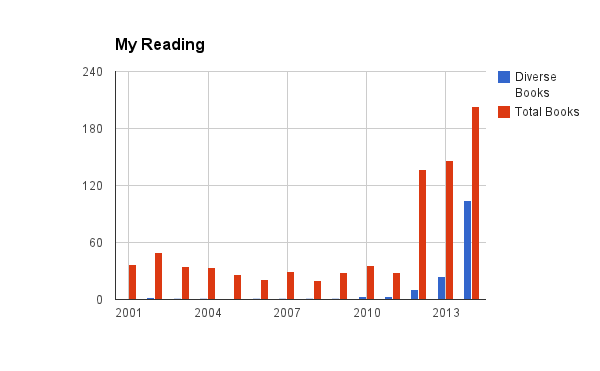
I read a lot of books last year (203, not that I’m bragging), and I was curious how diverse my selections were. I made an effort to read more diverse books in 2014 (in part thanks to We Need Diverse Books), but I was also curious about previous years as well.

So here’s a chart of the diversity of my reading going back to 2001:

My total books vs. diverse books Continue reading Why We Must Pursue Diverse Books

Top 5 Nonfiction of 2014

So I talked top 15 fiction and my entire 2014 reading list, now it’s time for my top 5 nonfiction.

I don’t read nearly as much nonfiction, so this list isn’t quite as amazing. But I’m pickier about my nonfiction selections. Any way, on with the list!

  1. The New Jim Crow: Mass Incarceration in the Age of Colorblindness by Michelle Alexander
    This book blew my mind. I underlined about half of it.
  2. Pastrix: The Cranky, Beautiful Faith of a Sinner & Saint by Nadia Bolz-Weber
    A heavily tattooed Lutheran pastor drops f-bombs while talking about the grace of Jesus. She’s tough and gritty, but she’s also honest and real in a way that’s so refreshing. She’s a reminder of what the church needs to be, and I love that so many of her stories are self-deprecating, not in a look-at-me, I’ll tell you how I’m not perfect which really means I’m perfect kind of way. Instead she’s full of real brokenness, real mistakes, real screw ups. That’s what faith is. That’s why we come together in communion, to receive grace and healing. There’s a lot more I could say about this book, and will say as I dive into it for both book club and Church Marketing Sucks, but I think it’s enough to say I’ll be reading it again.
  3. Show Your Work!: 10 Ways to Share Your Creativity and Get Discovered by Austin Kleon
    A great little book of encouragement and advice for the creative. Quick read and full of inspiration.
  4. A Year of Biblical Womanhood: How a Liberated Woman Found Herself Sitting on Her Roof, Covering Her Head, and Calling Her Husband “Master” by Rachel Held Evans
    I was initially reluctant to read this book. I’ve enjoyed Rachel’s work, but this felt like a rehash of the A.J. Jacobs book and, frankly, I felt like I didn’t need a primer on biblical womanhood. But I’m glad I finally read it. While I’m still not a fan of the “Year Of…” approach, she offers an approachable path to an otherwise overwhelming topic. She tackles poor biblical interpretation and male patriarchy with humor, grace and a little righteous indignation.
  5. I Am Malala: The Girl Who Stood Up for Education and Was Shot by the Taliban by Malala Yousafzai
    Incredible autobiography of a young girl in Pakistan fighting for her right to education in the face of the rising Taliban. It’s quite a history lesson and a needed new perspective. It takes a little while to get through the history and background, but then it dives into the guts of the story and moves pretty quickly.

Top 15 Fiction of 2014

I read a lot of books this year, so I’m offering my top 15 fiction books (here’s nonfiction).

I don’t think 2014 had as many home run reads as 2013 did, but there are still lots of good reads in this year’s list.

  1. Flora & Ulysses by Kate DiCamillo
    A beautiful, sparse, partially illustrated and wonderfully wacky story about a girl and a squirrel-turned-superhero. While it touches on over-the-top comic book superhero themes and ideas, it’s more down to earth with family issues and interested in deeper ideas like poetry. Yes, squirrels writing poetry! I read it out loud to my kids and it was an absolute joy to read. The voice and the flow of the language was very unique and just fun. I mean, c’mon, “malfeasance” is just fun to say.
  2. Ordinary Grace by William Kent Krueger
    A summer of tragedy in a small Minnesota town in 1961, as told through the eyes of a 13-year-old boy. It has an edge of mystery to it, but it’s mostly about this boy and his family, their relationships and ultimately a coming of age story. It deals with faith and tragedy honestly and realistically and is just saturated with perfectly honed writing. I was especially impressed by the clarity of the characters.
  3. Grasshopper Jungle by Andrew Smith
    This is the greatest novel you’ll ever read about six-foot-tall praying mantis soldiers devouring a small town in Iowa. It might also be the best book you read all year. It’s funny, weird, rambling, and full of the profanity and sex you’d expect from a 16-year-old narrator. It starts off as another story of an outcast teenager, struggling with life and his attraction to his girlfriend and gay best friend. But it turns into apocalypse by experimental mutant insects. It gets there (and holds together) thanks to the wonderful narration of 16-year-old Austin, a wannabe historian who lays it all out and explores the weird connections and fascinating underbelly of an economically depressed community in rural Iowa. It’s as if my two favorite genres—funny yet painfully honest teen novel and post-apocalyptic sci-fi got together to create a genetically modified hybrid super-genre that kicked every other book’s ass.
  4. Ask the Passengers by A.S. King
    Astrid Jones has never felt safe since moving to a small town. Her mom is image-obsessed, her dad is checked out, her sister is a people pleaser, her best friend lives a double life and, oh yeah, Astrid has a girl friend and hasn’t told anyone she’s gay. Not even herself. Since she can’t confide in anyone, she spends a lot of her time lying on picnic tables, sending her love to random passengers soaring past at 20,000 feet. In many ways it’s your typical teen finding out who they are story, but it’s so well-written and funny and fresh that there’s nothing typical about it.
  5. Forty Acres by Dwayne Alexander Smith
    Martin is invited to join an elite group of black businessmen, but he discovers they’re part of a secret society that wants to repay the evils of slavery by enslaving whites. It’s a fast-paced thriller wrapped around a thought-provoking idea. It’s terrifying, which is both as it should be and a little disturbing for what it says about myself.
  6. Fledgling by Octavia Butler
    Why do we read any other vampire novels? This one is it. Incredible. It starts with a young vampire awaking in a cave, disoriented and injured, suffering from amnesia and remembering nothing of what happened to her. As she pieces together the mystery it’s revealed that her dark skin is a genetic modification that allows her to stay awake during the day and survive the sun, but she’s hated by what amounts to vampire white supremacists. The action shifts from shadowy attacks to a court room like showdown and the intensity just ratchets up.
  7. The Boy at the End of the World by Greg van Eekhout
    A post-apocalyptic far-future where a boy wakes up in a broken ark to find himself the last human in the world. He has to adjust to a new world with a robot for a companion. It’s a great little kid’s story. I read it out loud to the kids and we all loved it.
  8. The Great Gilly Hopkins by Katherine Paterson
    Such a great and powerful story of a Gilly, the foster kid bouncing to a new home and starting over yet again. The defensiveness and fight or flight mentality is so spot on. She’s the world weary teen, wearing her guts and her prejudice on her sleeve, so eager to out-smart everyone and prove herself. It’s a quick read and the end comes too fast—you’ll be fighting the tears.
  9. Gone Girl by Gillian Flynn
    A husband comes home to find his wife missing, but nothing is quite as it should be. This mystery is a captivating page-turner that in the end was just plain terrifying, not from any horror but from the sheer craziness of what a person is capable of. 5 stars for being an incredible read. 4 stars because it gives me the willies.
  10. The One and Only Ivan by Katherine Applegate
    A short and lovely tale told from the perspective of a captive gorilla in a carnival-like mall. Not only is it a great little story, but the voice of Ivan is spectacular. I might be a bit biased since I listened to the audiobook and the voice work was very good, but the tone and voice of Ivan was just unique and so well done. I could listen to Ivan pontificate all day long.
  11. Lion’s Blood by Steven Barnes
    An alternate history where Europeans are enslaved by Africans. We see an Irish village sacked by Vikings, the people sold off in slavery, and forced to endure the passage across the Atlantic to an Islamic colony in North America at uneasy truce with the Aztec nation. It flips our racial expectations in a jarring way that’s hard to get used to (so used to the typical slave narrative, I realized halfway through that I was imagining the enslaved whites as blacks). Not only is it a jarring situation, but it’s a powerful story of master and slave.
  12. More Than This by Patrick Ness
    Desperate and depressed, Seth commits suicide and wakes up in an abandoned world. He finds himself inexplicably in his childhood home in England, across the world from where he drowned, and the world is dusty, overgrown and empty. Is he in some kind of hell? This one is weird and deep, but really good as you start diving down the rabbit hole.
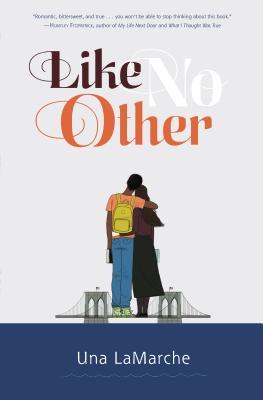
  13. Like No Other by Una LaMarche
    A lovely Romeo and Juliet story between a Hasidic girl and a black teen in modern day New York.
  14. Speak by Laurie Halse Anderson
    Malinda starts high school by calling the cops on a major party. She’s lost all her friends and everyone hates her, but the worst part is she tried calling the cops because she was raped at that party and never told anyone. Her freshman year continues to get worse as she tries to cope (or not cope) with what happened to her. Despite what feels like a cliche story (though I’m not sure I can name many teen girl is raped stories) it has a great voice and realistically moves through the aftermath of a traumatic event.
  15. Landline by Rainbow Rowell
    A workaholic mother sends her family off for Christmas vacation without her and as her marriage is on the brink she discovers a magic phone that connects her with her husband from 15 years earlier in the midst of another relational crisis. Complicated? Yes. It’s probably not as coherent as it could be, but it’s full of humor, warmth, random asides and near time travel. That’s always fun.

If you want to read more, check out my booklet 137 Books in One Year: How to Fall in Love With Reading Again.

2014 Reading List

Another incredible year of reading. Since writing about reading a few years back and formalizing some addictive reading habits (i.e., I’m a big nerd), my reading numbers just keep going up.

I hit 203 this year, which is just ridiculous. Though the number really isn’t important. You could easily accuse me of padding my numbers with middle grade and graphic novels (and that’s just too bad since reading is about enjoying what you read and not following some weird rules).

This year I read pretty widely. I’m still formulating my top reading lists (UPDATE: Here they are—fiction and nonfiction), but looking back it seems like 2013 had bigger hits. This year instead of coming up with a list of amazing reads—though I did find a few of those—I found a bunch of authors I really enjoy.

I took the rise of We Need Diverse Books to heart this year and found more diverse reads and authors. It’s not all multicultural either. I read a number of books about homelessness, foster care and disability.

Lots of fun reading this year. Let’s get to it.

You can also check out my previous reading lists: 2013, 2012, 2011, 2010, 2009, 2008, 2007, 2006, 2005, 2004, 2003, 2002 and 2001. Continue reading 2014 Reading List

Churches Suck at Welcoming People

UnwelcomeWalking into a church for the first time can be pretty scary. Churches aren’t very good at making people feel welcome. Which is why I’m proud to be part of the new book, Unwelcome: 50 Ways Churches Drive Away First-Time Visitors by Jonathan Malm.

It helps churches realize where they’re dropping the ball and scaring people away, whether it’s over-eager greeters hugging people (yikes!) or a cold congregation reserving seats (icy!). Jonathan offers practical tips and ideas, drawn from his vast church experience. He’s got funny stories that make the medicine easier to swallow.

You can grab some sample chapters at UnwelcomeBook.com to get a taste.

“‘Narthex’ sounds like a creature from a Dr. Seuss book. Make your signs visible and understandable.”

My Role in Unwelcome

This is the first CFCC book I didn’t contribute anything to, but I did handle the editing, proofreading and I’m very involved in the marketing. Rather than being bummed I don’t have my name on the cover, it’s kind of cool to see other folks’ stuff getting out there. Jonathan has a lot of great insight and experience (this is his fourth book this year alone!). I was also thrilled to get Kem Meyer to write the foreword.

“Don’t ask what it can hurt. Ask how it can help.”

Unwelcome Launch Week Sale

We’re also doing a big push this week only, so if you’re interested in Unwelcome, grab it now. The digital version is $7.49 and the print is $9.89, this week only. Next week they’ll go up to $9.99 and $12.99 respectively.

“You can’t force your congregation to be welcoming, but you can cast vision.”

33 Thoughts on Reading from Austin Kleon

I think perhaps Austin Kleon has reduced my book on reading down to 33 quick points. My book was pretty short anyway, but if you’re too busy for that, Austin’s version will work.

Austin Kleon is the creative mind behind Steal Like an Artist and Show Your Work!—both are good kick-in-the-pants books for creatives.

I can really get behind his points:

1. I will make time for reading, the way I make time for meals, or brushing my teeth.

4. I will read whatever the hell I feel like.

20. When I find an author I truly adore, an author who makes my gutstrings vibrate, I will read everything they have written. Then I will read everything that they read.

21. If I hate a book, I will keep my mouth shut.

Some of it is advice I’ve had a hard time following (though it’s still in my book):

8. I will not finish books I don’t like.

But this past week I really put it into practice. If a book isn’t doing it for you, move on. No obligations. I quit about four books in a row last week before finally settling on one I liked.

And I’ll let it go that some sound like he’s quoting me (steal like an artist), because it’s the best advice ever:

2. I will make an effort to carry a book with me at all times.

24. I will keep stacks of unread books at the ready.

25. The minute I finish a book, I will start a new one.

It’s a fun little post on reading. If you want to go deeper, you can check out my book, but this probably has you covered.

Like No Other by Una LaMarche

Like No Other by Una LaMarcheLike No Other by Una LaMarche is a lovely Romeo and Juliet story between a Hasidic girl and a black teen in modern day New York.

Maybe even more than the original Romeo and Juliet, this story is truly about crossing family lines. Devorah sees something beyond her strict religious upbringing and wants to know more. But instead of just condemning her former life, she still sees value in it.

And the nerdy Jaxon who never quite fit in or connected with a girl, found a girl, well, like no other.

Landline by Rainbow Rowell

I love Rainbow Rowell’s work and wanted to read her latest, Landline, as soon as I heard about it. It features a magic phone that allows you to talk with someone from a different time.  Time travel is always an awesome setup, and the phone-based approach is just fun.

So a workaholic mother, Georgie, sends her family off for Christmas vacation without her and as her marriage is on the brink she discovers a magic phone that connects her with her husband from 15 years earlier in the midst of another relational crisis.

Complicated? Yes. It’s probably not as coherent as it could be. The time travel effect was subtle and it took me a minute to catch up. But once you realize what’s going on, it’s fun.

Like other Rowell books, it’s full of humor, warmth and random asides. Plus you’ve got the time travel element, so that’s pretty great.

Forty Acres by Dwayne Alexander Smith

Forty Acres by Dwayne Alexander SmithForty Acres by Dwayne Alexander Smith is one of the most thought-provoking and terrifying books I’ve read this year. That’s both a good thing and a disturbing thing. Especially as I’m reading it in the aftermath of Ferguson.

The Story

Martin is invited to join an elite group of black businessmen, but he discovers they’re part of a secret society that wants to repay the evils of slavery by enslaving whites.

Every evil committed by white slave traders and owners against black slaves is being brought to bear on the ancestors of those slave traders and owners. Literally abducted from the streets and taken to this stronghold that purposefully resembles a Southern plantation—except the slaves are white and the masters are black.

So we’re talking servants, manual labor, treating humans like cattle, rape, abuse and more.

In some ways the story is completely implausible—a secret slavery stronghold, hidden in the middle of the United States? But that’s not the point. In other ways it’s brutally realistic. Martin is forced with a terrible choice and he has to do the unthinkable to even stay alive. The story also avoids the Hollywood approach with perfect plans and a Jason Bourne style escape. That makes it all the more real.

The story is a fast-paced thriller, but it’s wrapped around this thought-provoking and terrifying idea.

Reverse Discrimination

It’s terrifying in the way you’d expect. Any time I’ve read about slavery the evil is so apparent, so gruesome and revolting. It’s hard to understand how anyone could justify it. But it’s a part of history. People did do those things. Society accepted it. People were taught that those things were acceptable.

So Forty Acres is doubly terrifying because you have a group of people enslaving another group of people knowing full well the terror of what they’re doing. There is no societal justification. Just their own brutal vengeance. It’s an eye for an eye taken to it’s own logical end. And it’s not a pretty place to be.

But as I read it, I felt a deeper sense of terror as well. This is what white people fear. Whenever anyone talks about reparations for slavery or affirmative action or trying to find some measure of equality, there are some people who ask when is it enough?

There’s an unspoken fear in that question of giving up power. Making society equal means someone has to give up their power. Forty Acres presents an extreme answer to that question, an answer that’s morally abhorrent. But it’s also raising a serious question. No one would seriously suggest the scenario in Forty Acres, but there is a hidden fear that these conversations and questions would lead there.

Part of what I found disturbing about this story was my own reaction to seeing white people enslaved by black people. Somehow it seemed more unjust than the reverse, which is ironic since one happened and one is a work of fiction. I’m not saying this reaction reveals some kind of closeted racism, but I think it reveals bias and white privilege within myself that I’m barely aware of.

Let me put it this way: The image of a white man beating a black man, while vile and repugnant, isn’t that jarring to me because it happened over and over again as part of our ruthless history of slavery. But the image of a black man beating a white man, I found completely jarring. Both are horrible, but I have an easier time moving past one of them. And I think that’s a product of institutional racism or white privilege or whatever bias I bring to the table.

An Evil Legacy

In 1865—149 years ago—slavery was fully abolished in the United States with the passing of the 13th Amendment. But the legacy of that evil institution continues to haunt us today. Despite many advances in civil rights, racism and prejudice persist. It’s not something we simply move past. There’s often unconscious prejudice we don’t even realize we have. Forty Acres taps into all of that, making it one of the most powerful books I’ve read this year.