Olympic Fever

We’ve been swept up in Olympic Fever around here, taking in as much Olympics as we can. And since it’s a vacation, I’m probably watching more Olympics than I have in a long time. It’s really fun getting into the drama and the stories of each athlete.

But I have to say it breaks my heart when the silver medalist breaks down in tears. I know it’s not gold, but you’re second place in the entire freaking world. Buck up.

That was the image we saw of Russia’s Victoria Komova after the women’s individual all around. She lost to Gabby Douglas (Could anyone have a more infectious smile? Yes, Missy Franklin.) and collapsed in tears, inconsolable. She could barely even stand to wear the silver medal.

I get the disappointment, but it’s also the Olympics. You’re awesome. In a world of 7 billion people, you’re number two.

That was the sentiment of the jovial Missy Franklin: “I don’t think fourth at the Olympics is a disappointing swim at all,” she said, talking about teammate Lochte’s finish (though she had a fourth place of her own).

Then there’s 15-year-old Katie Ledecky who destroyed the field in the 800 meter freestyle, winning by more than 4 seconds. Afterword when asked how she did it, she said something to the effect of, “I set high goals and reached for them, and this just blew everything out of the water.” She gives the impression that her “high goals” were far short of gold. But there she is, a shocked and glorious winner.

Then there’s the Chinese athlete who won silver and broke down crying on live national media coverage, apologizing for letting his country down (it was an NPR story, can’t find it online). That’s harsh.

There’s also the 3-time gold medal winning Chinese diver who after winning her medal learned that her grandmother had died–more than a year ago. And that her mom had been battling breast cancer for years. Her family didn’t want the death to distract her from the Olympics. That’s a little too intense.

The Olympics are an amazing opportunity and a chance to celebrate human achievement and skill. It shouldn’t be a time for sore losers. Personally, I’m sitting here on the couch amazed at how these athletes can contort their bodies, whether it’s the cyclists pouring on the speed for the last sprint, the runners with their feet flying a fluorescent Nike blur, the gymnasts spinning in the air (and with biceps bigger than my head) or the soccer players running for 45 minutes straight. It’s incredible and inspiring.

Makes me want to run and bike and swim. And yesterday I did. One lap of the pool left me gasping. Not like the women’s 100 meter sprinters who hardly looked winded. That’s just incredible.

Teaching Lexi to Ride a Bike

One of my projects this summer has been to teach Lexi how to ride a bike. We’re almost there.

Yesterday she went down the alley for stretches all by herself:

Today she went down the entire alley all by herself (with me running alongside in the excessive heat warning). She still needs some help starting and lots of practice, but we’re almost there. I’m still waiting for the first big fall and bigger tears.

Teaching a child how to ride a bike is full of lessons for a parent:

  • I think one of them is start early. I see kids half Lexi’s age riding bikes without training wheels all the time and I realize we’ve put this off.
  • I also think it’s about taking baby steps. Riding a bike involves a lot of skills at once, from pedaling to balancing. Anything you can do to learn one of those skills at a time instead of both at once is huge step up. That’s why we got Milo a kick bike. That’s why I took the training wheels and the pedals off Lexi’s bike at the same time so she could work on balance.
  • We also tried one of these co-pilot bike trailer things, in part to teach her balance but also to get her used to the idea. It’s also been a good way to teach her safe bike habits while I’m still in control (biking in the city is a bit different than the suburbs I biked in growing up).
  • But in the end it really comes down to practice. Running up and down the alley with Lexi for several days in a row is what finally got us the break through. It’s kind of the secret to most of life—you keep on trying until you get it. I hope Lexi’s starting to understand that (though yeah, she’s 6, it’ll be a while before that sinks in).
  • And if what Lexi really needs is practice, what I really need is patience. Loads and loads of patience. Oh my goodness did I need patience. Lexi’s not a super athletic kid (what can I say, she’s a Hendricks) and she also gets freaked out trying new things. She had a lot to overcome here and that required a wealth of patience on my part. Me getting mad or short with her would just shut her down. Having the patience to wait her out, to keep trying, to notice tiny improvements and praise the heck out of ’em. I don’t remember my dad teaching me how to ride a bike (oddly I remember when we took my brother out to learn how to ride a bike, but I don’t remember learning myself), but I imagine he needed the same boatload of patience I needed. I’m probably more like my dad, and Lexi is more like me, than I ever would guess.

We’re almost there. I think bike riding is one of those awesome things that can give a kid an incredible amount of freedom. There’s nothing like a summer of bike riding, of stretching your limits, of putting fun and adventure within reach, of simply feeling the wind in your hair. I’m almost as excited as Lexi is.

The Freedom to Disagree

I just finished reading Held at a Distance by Rebecca Haile. It’s a memoir about a woman who lived in Ethiopia until she was 10. Her father was wounded by the Derg in the aftermath of the revolution and her family eventually had to flee Ethiopia. The memoir is her experience returning to Ethiopia as a 36-year-old American.

I’ve been reading the book with the backdrop of the recent Supreme Court decision upholding the Affordable Care Act (Obamacare) that has sent people into a tizzy—either expressing dismay at how the country is going down the toilet or complete euphoria that justice is coming to health care.

Full disclosure: Personally, I’m happy with the Supreme Court decision, though this doesn’t seem like a perfect law that’s going to fix the mess that is health care. I hope it’s a step forward. But I find the reaction to the decision more interesting than the decision itself. It makes me wonder how people have reacted to other historic court decisions. Were people this dismayed after the landmark 9-0 Brown vs. Board of Education decision that overturned segregation? (I’m not trying to compare this decision to that one in historic terms, just wondering how people have historically reacted)

All the cries of America going down the tubes seem especially disheartening to me. If anything, the will of the people has spoken. A law was passed by a Congress elected by a majority (multiple times—senators and representatives), signed into law by a president the majority elected, and upheld by a Supreme Court made up of justices appointed by past presidents from both parties and approved by a Senate controlled by both parties. Whether or not you agree with the decision, democracy happened. Complain all you want if you don’t like it, but this is government of the people, by the people and for the people. The law is constitutional, if you don’t like it you have all the legal power of democracy to change it. [Sidebar: And I hope my stance in this last paragraph would be the same no matter how the decision came out. It’s easy to make this statement when “your side” wins.]

Back to Ethiopia
I say all that because that’s what was going through my mind as I started reading about this family torn apart by military and socialist revolution in Ethiopia. When the government was overthrown in 1974, military rulers took over and imposed socialist ideals on an impoverished country. But it was really just a dictatorship disguised as socialism. Anyone who disagreed with the new government was seen as a threat. They were targeted, harassed, attacked and in many cases killed. The Derg’s iron-fisted rule continued until 1991 when they were overthrown. The government that followed is, according to Haile, less violent but more of the same. Dissenters are still arrested, censorship continues and the press is not truly free (I should note here that my understanding of Ethiopian politics is extremely limited and I’m basing all of these statements on Haile’s 2007 memoir. Take it with a grain of salt.)

An obvious lesson from Ethiopian history would be that when you can no longer disagree well with your political opponents, you’ve got a problem. When you vilify your opponents, you’re in trouble. You’re just a step away from outright attacking them. And when that happens you’re no longer pushing for a democratic ideal, you’re forcing your own opinion on someone else.

Today, the Fourth of July, is about celebrating our American Independence. As we celebrate and approach an election in the fall, we seem more divided than ever. But in our division, we must find a way to be united. We must find a peaceful way to disagree with our opponents. Disagree all you like, but democracy means that we come together and the majority rules under the Constitution (i.e., the majority might not have voted to end segregation, but it was still deemed unconstitutional).

Because the end of our independence happens when we’re afraid to disagree.

Say Hello to The Stephanies

It’s only the second day of Lexi’s summer vacation and she already needs a project to keep her from being bored. OK, I need her to have a project to keep her from being bored.

A while back we wrote the outline of a book together. I asked Lexi who she wanted the characters to be, what she wanted to happen and kind of made up the rest. She drew one picture and it got filed away for another day.

Today was that day.

The Stephanies
We pulled out The Stephanies and started work on our book. I’m the writer and Lexi is the illustrator (apparently on Saturday we’re going to switch roles for her Star Wars book). I had to explain how illustrating works, how you have sketch things and draw them and redraw them and draw them again to get it just right. I explained how she had to practice drawing each Stephanie so they looked the same in each scene. I also explained how this wouldn’t be a quick project that we’d finish up today—it’d take a while. (All of which would probably make me a horrible art teacher)

So I spent the afternoon writing and Lexi spent the afternoon drawing. I have most of the story, though the ending needs some work and it needs lots of polishing (my last children’s book was Mike, The Cat, written when I was a child). Lexi has a lot of good drawings, though I think we need to pick some new colors or figure out what’s wrong with the scanner (the girls should be wearing dresses that are highlighter pink and yellow).

So that’s your preview of The Stephanies. It’s going to be awesome. I’m hoping we can release it later this summer, probably as an ebook and maybe as a full-color, printed book (I’ve been wanting to experiment with that for a while).

What About Milo?
And why isn’t Milo involved in this little project? Mainly because I insisted the kids clean their rooms on the first day of summer vacation and then keep them clean. Lexi finished after an hour or so on the first day. Milo kept procrastinating, not doing it and somehow completely avoiding it. For two days. He finally finished the half hour job tonight, so maybe I’ll have to find a role for him tomorrow.

Maybe he can be our publicist.

Lexi’s Last Day of Kindergarten

168th Day of School - Last DayIt seems like only yesterday Lexi was heading off to her first day of kindergarten. She was over-the-top excited and Milo burst into tears.

Today was her last day of kindergarten. She’s older, wiser and taller.

The last day celebration included a cookout with Pete the naturalist at the Dodge Nature Center, featuring mini hot dogs (Milo ate half the pack) and pizza. Then we headed back to school to hear about some of her favorite things from throughout the year and every student received an award for following one of the school’s five overall rules.

Lexi was recognized for “safety,” because she always brought the right gear. I think that means I should get an award for sending my kid to school prepared (which usually meant stopping her on the way out the door and insist she wear something more appropriate). She also got the award for making sure everyone else was being safe too, which I’m pretty sure means she’s just bossy. She practices all day long on Milo, so it’s good to see it’s paying off.

It’s been a fun year watching Lexi grow. I think the social aspect of kindergarten—learning how to interact with other kids, following the rules, being prepared—has probably been the most important, though it’s also been cool to see her learning the academics. She’s learning how to read, slowly and with more and more confidence. Having a kindergarten teacher for a mom, some people expect reading to be a serious and early milestone in our house. But it’s actually counter-productive to teach kids to read too early (Abby could give you all sorts of reasons why—I’ll leave that blog post to her). It’s important to let them go at their own pace. And it’s been fun to see that with Lexi, to see her start to read signs in stores and read stuff over our shoulder. She’s still gaining confidence with reading books, but she’s getting there.

I’m also trying not to be too proud that one of her favorite things in school was writing.

Finally, the end of the school year means the end of a little project of mine, the Days of School. It started with me taking pictures on the first day of school (I have an addiction to feed). Then as we waited for the bus on the second and third days of school Lexi kept asking me to take pictures. So we started taking a picture every day. I think we only missed one or two days when Lexi actually went to school, and of course we missed all the days she was absent (and since she had mono in the fall, there were a lot of those). But in the end we have 151 pictures of Lexi going to kindergarten.

As we went outside to take her picture today I told her  we were taking her last picture. She told me, “Nope, you’re taking pictures in first grade too!” So we’ll see how long this thing continues.

Check out the Days of School:

Eat My Own Words: Got an iPhone

Guess it’s time to eat my own words. Didn’t even make it a year.

As much as I loved having a cheapskate cell phone plan, I’ve graduated to an iPhone.

It’s an early birthday present from Abby, and I love it. My favorite part is actually the way it mashes multiple things together and simplifies my life. I’m still not much of a cell phone talker, but I take way too many pictures, I need my calendar and address book, and while I don’t always get lost, having directions and maps handy is a huge plus.

So being able to call for help when the car dies (one of these days it will) is nice, but having my computer in my pocket is what’s worthwhile.

Forced to Bear Arms

Ran across an interesting article digging into Congressional history to defend Obamacare. The current argument before the Supreme Court (as I probably inaccurately understand it) is whether or not the government can issue an individual mandate, i.e., can the government force an individual to buy something.

The article points to a 1790 law that mandated health insurance. Interesting example. But I’m so not interested in arguing about the validity of Obamacare (so not interested).

The interesting part of the article is when they point to a 1792 law that made gun ownership not just a right but a requirement:

In 1792, a Congress with 17 framers passed another statute that required all able-bodied men to buy firearms. Yes, we used to have not only a right to bear arms, but a federal duty to buy them.

That’s hilarious.

According to Wikipedia it was part of a Uniform Militia law, which raised up state militias as opposed to a federal army. White men were required to register with the militia and have a gun ready to go. It was never fully enforced and there was never widespread compliance.

Oh so wacky. I wonder how that’d go over today?

Sidebar: It’s funny what we expect out of our political system. Sometimes we act like certain things are anathema to our way of life, but it turns out it’s all shifting and moving, depending on the issue, the era and who’s in charge. Sometimes an idea seems historic and foundational (like “under God” in the pledge, added in the 1950s), but it’s not.

Sidebar II: We can’t talk about the right to bear arms without mentioning the awesome T-shirt (or pick your favorite permeation).

Tornado Destroys Family Farm

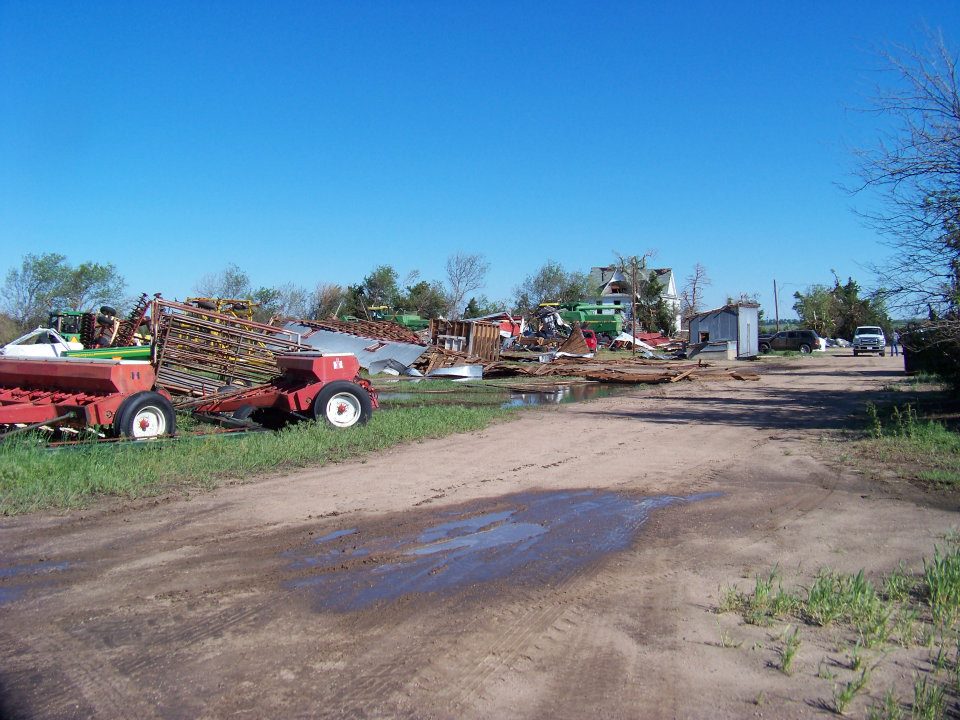
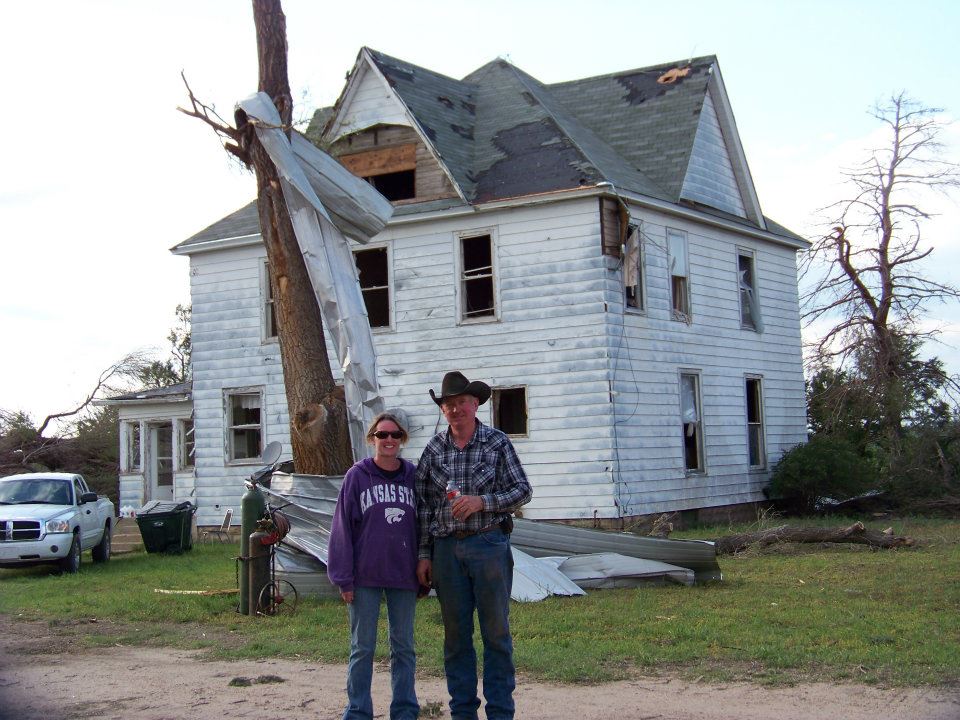
My uncle’s farm outside Raymond, Kansas, was hit by a tornado late Saturday night. Everybody’s OK, but the devastation is pretty complete. The farmhouse is still standing, but the roof was lifted up and the windows blown out, so that doesn’t mean much.

While my uncle currently lives there, this has been the family farm. My grandparents originally owned the house and my mom grew up there with her siblings. My aunt was married there (I was the ring bearer in the wedding, though I seem to remember thinking I was the ring bear). When my grandparents “retired” (?) and moved to town, my uncle and his family moved in. My cousins grew up there and I have so many memories of going out to the farm. We’d play flashlight tag, truth or dare, light firecrackers, build forts in the old scrap iron pile and fight like siblings inevitably do.

There are a lot of memories in that place. Here’s what it looks like now:

I don’t have a very good before picture, but here’s my grandparents standing in front of that same door celebrating their 25th wedding anniversary. And here’s my aunt standing on those very steps at her wedding. A little generational history at that old farmhouse.

The devastation is much more complete away from the house. A giant machine shed and two-story wooden barn were completely destroyed. In this picture those buildings should line the left side of the road. In the distance you can see a combine and several vehicles that were lined up inside the shed, which is now completely gone.

I remember that driveway feeling crowded with buildings. Not so much anymore. Now it’s mostly debris. A concrete silo was completely knocked down and debris is strewn all over, sheet metal wrapped around trees and even a pipe piercing a tractor tire.

My uncle heard reports of a tornado near Raymond on the radio and made for the cellar. Five minutes later his ears popped, then there was a loud boom and then nothing but the sound of falling glass. That was it.

This picture is probably the most brutal, my grandparents, picking through the debris. I don’t know what they hope to accomplish there, and maybe the futility of it is what makes it hurt all the more.

But then there’s my favorite picture. Among all that chaos and devastation, my uncle and cousin are standing there smiling:

Its just another storm to weather. After all, it’s just stuff.

Bizarre Stories: Sex on the Beach

There’s a story in the Pioneer Press this morning about the Wisconsin DNR cracking down on nudists. It seems the nudists are having sex in various public places (you know, the beach, the woods, sand bars…) and exposing themselves to passing canoeists. It’s been a problem for decades and has resulted in bans on nudity on public land, lawsuits and even a pastor protesting at the beach.

Here’s the best part of the article:

“They were having sex right on the islands, the sandbars, when the river was lower,” said Ruth Bender, who owns property directly across the river from the beach. “People can’t understand something like that is going on. That’s a nice section of the river. I don’t know what fun they get out of that.” (emphasis mine)

Um… they’re having sex. I’m pretty sure that’s the fun they get out of it.

Second best part of the article? The offending beach is in Mazomanie, Wis., which is where we got our dog, Mazie, and then named her after the town. My dog is named after an infamous nudist beach town (in Wisconsin of all places).

The Lily Pond at Como Park Returns

Como Park Lily Pond plans - 2012The City of Saint Paul has secured Arts and Cultural Heritage Legacy Funding to restore the Como Park Lily Pond. The pond last held lily pads in 1926 and has mostly been an empty concrete pond since. The 1903 fieldstone and concrete bridge will get some repairs and a new railing. The pond walls and bottom will be completely replaced, though it will have the same footprint and use fieldstones across the top like it currently has. The north pool will feature a water cascade and there will be a fountain in the south pool, both to help circulate water. The pond will feature native aquatic plants, so no more heating the pond and bringing in giant, exotic lily pads. There will also be a seating area north of the pond and another to the west with a pergola.

No completion date has been given, but the project appears to already be underway.

The Lily Pond has always been one of my favorite spaces in that grand public park. There’s an intense feeling of history there that’s hard to escape and it’s a fun place to wander around. I’m curious how that will translate with all the renovations. I’m excited that they’re doing something with the old Lily Pond, but part of me also wonders if it’ll still be the old Lily Pond. Part of its appeal was that it was empty and neglected, an odd pond with no particular use. Hopefully the restored pond will capture that sense of history that made it so great.

Lily Pond at Como Park - 1910 Lily Pond at Como Park - 2007