Category Archives: Society

How Do We Overcome Our Bi-Partisan Ignorance?

Ignorance stalks us wherever we go. Stupidity too—it’s easy to lash out in anger or dismissiveness. And maybe arrogance as well, to think that none of these apply to us. To me. We—I—live a great contradiction.

It’s so prominent in the political debate in this country right now—filibusters and sit-ins over gun rights, refusing to consider Supreme Court nominees, etc.. One side decries the other side’s actions, even though the first side has used the exact same tactic in the past. Both sides do it.

And so it goes. And that’s just in politics.

I read a lot. Some might say too much. In that reading I come across portrayals of overwhelming ignorance. Just this morning, in a matter of pages I read about The Colored Motorist’s Guide that told black people in the first half of the twentieth century “where they could and could not sleep, in what towns the citizens would shoot them if they stayed after dark,” and then that “deaf schools banished sign language, declared it backward and a threat to the wholesome spoken word, subscribed to the theory that sign language would encourage the deaf to marry only each other and create a perpetuating race of non-hearers, and swaddled the hands of their most defiant students in thick cotton mittens.” Continue reading How Do We Overcome Our Bi-Partisan Ignorance?

Can We Have a Little Compassion?

I shared this article on Facebook last week, but I think it’s important enough that I’m going to share it again:

There’s a lot of freaking out happening right now over gender issues. I think much of it comes down to misunderstanding. Transgender is a weird issue and a lot of us don’t understand it.

If we say that we love people, then we need to try to understand it and have some compassion. That article is a start.

Because you may not know it yet, but you probably know a transgender person. I didn’t know anyone personally—until today. We need to listen. We need to [try to] understand. We need some compassion.

And we’re going to ask dumb questions or say offensive things. And we’ll need grace.

I came across this passage in the book I’m reading right now, Silver Linings Playbook by Matthew Quick. The main character, Pat, has some kind of mental health issues and he just read the very depressing The Bell Jar by Sylvia Plath. Pat asks his therapist why kids in school should have to read it:

“Life is hard, Pat, and children have to be told how hard life is.”

“Why?”

“So they will be sympathetic to others. So they will understand that some people have it harder than they do and that a trip through this world can be a wildly different experience, depending on what chemicals are raging through one’s head.”

Some of us have life easier than others (another way to describe privilege). And so before we judge people based on that or apply our theology or political ideology to it, I think we need to have some compassion.

What other response should we have to hurting people?

Transgender: Love or Legislate?

There’s no epidemic of bathroom assaults in this country. You know what there is? A rash of suicide among trans people—41%.

Love > Fear.

I really don’t want to get into some online debate about this. I dread it. But when I see people spewing hate and pretending it’s reasonable, I can’t keep quiet.

Trans people are more likely to be harassed, bullied, abused and rejected. It’s no wonder they’re trying to kill themselves at staggering numbers.

That should break our hearts.

But instead of loving, we’re legislating.

Let’s be honest: the transgender experience is weird and complicated and confusing. Most of us don’t understand it. Imagine trying to live it.

Yet instead of compassion, too many react in fear. We refuse to consider their actual experience and assume we know better. When will we stop trying to inflict our morality on hurting people?

Look: I don’t care about the theology or morality or whatever surrounding the transgender issue. All that sermonizing doesn’t mean anything when kids put knives to their wrists.

You either care about that person or you don’t. You either love them like Jesus did—right or wrong, accident or choice, sin or something else—or what the hell are you doing?

We hate one another too easily. That’s not the gospel I believe. Sometimes I think we’ve forgotten the Good Samaritan.

Want to understand this issue better? Try talking to a trans person. The next best thing: Try reading their experience. It’s a start.


  • Rethinking Normal: A Memoir in Transition by Katie Rain Hill
  • Beyond Magenta: Transgender Teens Speak Out
  • Some Assembly Required: The Not-So-Secret Life of a Transgender Teen by Arin Andrews
  • Young adult fiction: Beautiful Music for Ugly Children by Kristin Cronn-Mills
  • Middle grade fiction: Gracefully Grayson by Ami Polonsky


Have some compassion, even if you don’t understand or disagree. These are people too.

Nekima Levy-Pounds on Racial Justice in Minnesota

I went to the Martin Luther King Jr. Day event at Luther Seminary today to hear Nekima Levy-Pounds speak. She preached.

Powerful words like hers are so needed today and every day.

  • We are part of the solution or we are part of the problem. Our silence makes us culpable.
  • We’re living off the legacy of Hubert Humphrey, but we haven’t done the work.
  • Instead of compassion we’re taught to look the other way and focus on self preservation.
  • We’re told to trust the law, to rely on the system. But the law gave us slavery. The system gave us Jim Crow. It gives us mass incarceration today.
  • Public policy changes incrementally or not at all. Sometimes you need direct action to disrupt and get attention.
  • People are not going to be Minnesota nice when their brother is killed.
  • We need to personalize these injustices.

So many thoughts.

I think our problem today, especially here in Minnesota, is that we fall back on a lot of excuses instead of engaging in the hard work of racial justice.

We talk about the importance of supporting our police officers instead of acknowledging the disparities in our criminal justice system.

We complain about the disruption of protests and plea for tactics that will bring people together, when those disruptive protests are the only effective way to bring attention to the issues. Martin Luther King Jr.’s “Letter From a Birmingham Jail” was a response to white pastors urging King to find less disruptive tactics.

The reality is that there is very real and justifiable rage in our communities of color. If you don’t know that or understand why that rage is happening, you need to listen and start understanding instead of constantly dismissing.

Many of these protests that some people bemoan and dismiss are the only reason Minneapolis isn’t burning to the ground. These protests are offering productive ways to channel that rage. The 4th Precinct Shutdown protest in Minneapolis after the police shooting of Jamar Clark is a perfect example.

This work of racial justice is hard. It’s not going to be a simple conversation on social media or a blog post. It’s going to take personal investment instead of self preservation and defense.

My favorite story that Nekima Levy-Pounds shared is from the 4th Precinct protest when they were going to shutdown I-94. She was talking about it with her 10-year-old son.

“I might be arrested tonight, are you OK with that?” Nekima asked.

Her son responded, “Can I be arrested too?”

Suicide on the High Bridge

You know what sucks? Having to explain to your kids why there are ribbons decorating the High Bridge in St. Paul. It’s not exactly a festive occasion—it’s because of the high rate of suicides.

Lots of people are jumping off the bridge to kill themselves, and the ribbons are an attempt at suicide prevention.

Another person jumped today.

In 2008 the City Pages called the bridge a “suicide hot spot,” and offers the chilling detail that some of the people who jump from the bridge actually survive.

In terms of statistics, the most common method of suicide is firearms. But the public nature of jumping seems to capture the public conscience.

If you are thinking about committing suicide, please talk to someone. You can call the National Suicide Prevention Lifeline at 800.273.8255 to get help.

Help Mark Horvath Help Homeless Veterans

Update: Thank you. By the time Mark crossed the finish line, we raised $2,170 for homeless veterans. And that money will be tripled. Thank you!

My friend Mark Horvath is doing a 5K walk to help end veteran homelessness and he needs our help. He’s got a $5,000 match—so every dollar you donate gets doubled, up to $5,000 [plus another foundation match triples your donation]—yet he’s only raised $100 $645 so far. And the 5K is on Saturday.

So help me help Mark help veterans who are homeless. Donate now.

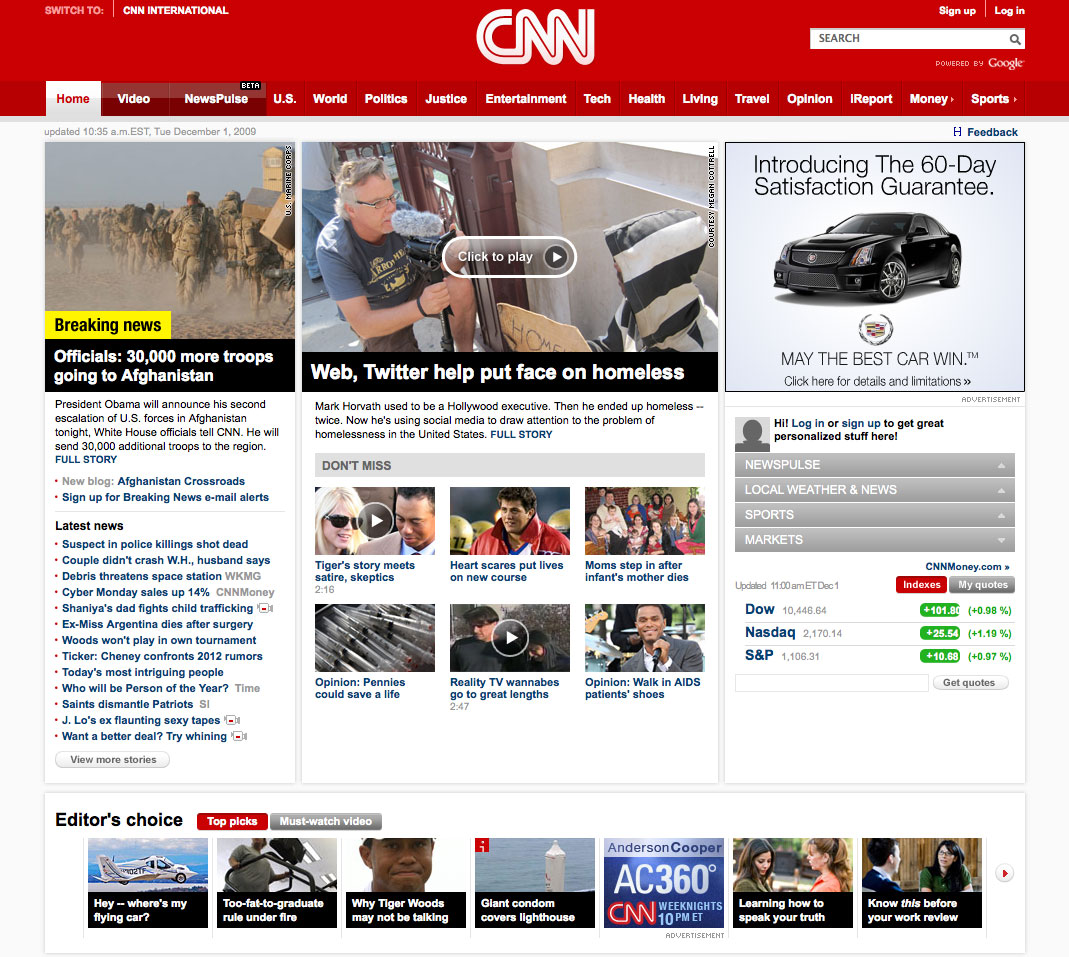
InvisiblePeople.tv's Mark Horvath on CNN.com
InvisiblePeople.tv’s Mark Horvath on CNN.com

Who Is Mark?

Mark Horvath is the founder of InvisiblePeople.tv, an nonprofit that gives people who are homeless a voice by telling their stories. Mark has worked tirelessly to end homelessness because he was once homeless himself.

I’ve supported Mark every chance I get, including a book project, a half-marathon fundraiser, interviews, articles and more. I love the guy, I love what he’s doing. Mark is the real deal.

Please donate to support Mark.

Mark Horvath Ready for Action

What’s the Charity?

Mark is participating in the United Way Home Walk, supporting the United Way of Greater Los Angeles. I think that’s a name we can trust.

Plus, Mark lived in Los Angeles. He knows what’s what and I trust that Mark would only raise money for organizations that are truly doing good.

Please donate to support the United Way.

Homeless Veterans?

Yeah. Like Dawn. She served in the Navy for seven years, came home to a difficult situation and found herself homeless. She lived out of her car for two years.

Our veterans deserve better. And thanks to the United Way, she now has a place to call home. Watch Dawn’s story.

Please donate to support Dawn and other veterans just like her.

Refugees vs. Veterans?

I don’t want to get too political on you, but lately all the garbage going back and forth on Facebook is making me twitchy. Seriously, I want to stab myself with a spork.

The one that makes me feel the most stabby is the meme pitting Syrian refugees against homeless veterans. It argues that we’re not taking care of our U.S. veterans, so how can we take care of Syrian refugees.

Let’s forget that the meme assumes we can’t do both. Let’s forget all the politics that so deeply divides us. I think we’re supposed to help people in need. It’s that simple.

Well, here’s an opportunity to help homeless veterans. So let’s help them.

Please donate to support a less stabby Internet.

Did You Say Matching?

Yes. Every dollar donated is matched. You donate $10, it becomes $20. You donate $50, it becomes $100. It’s magic!

Up to $5,000 will be matched. So if we can raise $5,000, that’ll be $10,000 to help homeless veterans. That’s a win.

Please donate to support magic doubling money for a good cause.

UPDATE: So Mark has a donor personally matching the $5,000 he raises, as I mentioned above. But also, the Conrad N. Hilton Foundation is offering the Hilton Challenge. For every team that raises $5,000, they’ll match it. So your contribution will not just be doubled, it will be tripled. Like money, money, money. It’s like exponential giving!

How Soon?

Now! The United Way HomeWalk is Saturday, Nov. 21. That’s like 36 hours from now. Time’s a wastin’! We need to raise that money today. Not tomorrow. Not next week. Now.

Please donate right now.

Thank you.

From Ferguson to Charleston: Institutional Racism

In the past year racism has been in the spotlight more than any time I remember in my life. From Ferguson to Cleveland to Baltimore to McKinney to Charleston, from police brutality to a white supremacist terrorist. It’s prompting some honest and difficult conversations. I hope you’re joining them.

These events and conversations are important to me. The fact is systemic racism continues to be a problem in America today. It’s not overt like it was during Jim Crow. It’s often subconscious. It’s often systemic. It’s often something we (I) don’t even realize we’re doing. But it’s there.

What’s so amazing about this moment right now is that we’re actually having those conversations. I’m completely shocked that the Charleston shooting has turned into a reexamination of the Confederate flag. In some ways that’s getting lost in the weeds, and if we think removing one symbol is going to change much we’d be mistaken. But it’s a small step of progress to recognize the oppression of our past.

People much smarter than I are weighing in on this issue and saying much smarter things than I ever could. So rather than ramble on, I’m going to link to them.

I’ll just close by saying I think we’re watching history happen. Something is changing in America right now. Let’s be a part of making that a change for the good of all people.

I doubt I’ve lived this out very well this past week (or even months as this conversation has gone on), but it’s a powerful prayer to live up to:

Lord, make us instruments of your peace. Where there is hatred, let us sow love; where there is injury, pardon; where there is discord, union; where there is doubt, faith; where there is despair, hope; where there is darkness, light; where there is sadness, joy. Grant that we may not so much seek to be consoled as to console; to be understood as to understand; to be loved as to love. For it is in giving that we receive; it is in pardoning that we are pardoned; and it is in dying that we are born to eternal life. Amen.
(St. Francis)

Oregon’s Racist History

Oregon’s original constitution included a “bill of rights” that banned black people the state.

The state used a popular vote to adopt their constitution and had separate votes on two  issues. Oregon residents voted to outlaw slavery with a strong 75% majority. But an overwhelming 89% voted to ban black or any mixed race people from the state.

The laws were technically overturned by the federal government’s 14th amendment, which Oregon ratified in 1866, but then un-ratified in 1868 (largely symbolic).

We like to whitewash our history and think that segregation and racism only happened in the South, or that being anti-slavery meant people weren’t racist. Not so.

I first heard about this history at the White Privilege Conference and Gizmodo has a fascinating blog post about it.

And of course Oregon isn’t the only Northern state with a troubled racial history. The Gizmodo blog links to a story about a black family buying a home in a white, Minneapolis neighborhood in the 1930s and the riot that ensued.

White Privilege & the Ferguson Report

Last week I attended the White Privilege Conference in Louisville, Ky. The name of the conference always raises eyebrows, especially when people don’t understand the concept of white privilege.

The conference gets criticism on both sides. It also gets the attention of the KKK, which tells me they must be doing something right.

So is it a bunch of white people sitting around in a guilt trip? No. It’s not the Privileged White People Conference. It’s about realizing the various kinds of bias we have in our lives—racial and otherwise—how it often leads to oppression of various forms, and what we can do to stop it.

The fact that I’m a white, anglo-saxon male with a college degree gives me certain privileges and biases that color how I see the world. It doesn’t mean I’m a racist, but it does mean I’m immersed in a society built on discrimination. Many of those biases have unknowingly become a part of who I am. It comes up in everything from the color of bandages (why does the “flesh color” match my skin but not my son’s?) to how we related to the police.

For example, Franklin Graham seems to have a different relationship to the police than the black citizens of Minneapolis.

“Most police shootings can be avoided. It comes down to respect for authority and obedience.” -Franklin Graham

“People just feel alienated from the police, or don’t trust the police, or don’t think maybe that the kid is going to be treated fairly, or don’t think that calling the police makes a difference, or don’t feel empowered to engage the police.” -School Board Member Don Samuels, who lives in predominately black North Minneapolis (in a report on the racial bias in Minneapolis policing)

Continue reading White Privilege & the Ferguson Report

Reflections on MLK’s Birthday

This week #BlackLivesMatter protesters were charged with various crimes and restitution for the Christmas protests at the Mall of America. At the same time I’m reading the writings of Martin Luther King Jr. and hoping to actually attend MLK Day events instead of just enjoy another day off. I’m troubled by the continual question of whether or not black lives actually matter—questionable police killings, terror in Paris that trumps massacre in Nigeria, and condemnations for protests that inconvenience people.

I’m frustrated by all of it. So I rant…

In this day and time when we celebrate the work and life of Martin Luther King Jr., why is it that we sanitize the man?

We want to make him a hero of racial harmony, the winner in the battle for freedom and equal rights.

We forget his challenge to the churches of the time, who stood by in silence while King wrote to them from his jail cell on scraps of paper. We forget that King not only wanted racial equality, but progress. Jobs, housing, education—King wanted fairness and equality in all of these areas of life. He was anti-war and even argued for a nationalized healthcare system.

We forget all those unrealized dreams of Martin Luther King Jr. Instead we focus on free at last. We look around and decide that segregation is gone so we must have made it to the mountaintop.

Such a vision of King allows us to declare his work done.

Here in the North we like to congratulate ourselves that we weren’t the center of marches and protests, we didn’t unleash dogs and fire hoses.

Yet here in the North, in Minnesota where we pride ourselves on being nice, it’s really just a facade. While our education system is the pride of the nation, it fails Minnesotans of color. Our achievement gap is among the worst in the nation. Blacks make up only 5% of Minnesota, yet they fill 37% of our prisons—the black to white disparity in our prisons is among the worst in the nation (Council on Black Minnesotans Disparity Analysis, PDF). Across the country the net worth of blacks is one-thirteenth the net worth of whites.

50 years after free at last why do these basic inequalities still exist?

If we truly believe that all people are equal, if that’s the foundation of our society, the basis of our freedom, the ethos of America itself—then why do such disparities exist?

It is time to open our eyes to the casual, hidden racism in our own hearts. It’s time to stop thinking that we are post-racial and realize the million tiny ways that our society is still segregated, still racist, still separate and still definitely not equal.

Disagree? Then why are black people 20 times more likely to be stopped by police? And it’s not justified, because “whites stopped during traffic searches were found to carry contraband at higher rates than blacks and other minorities, [yet] resulting arrests and prosecution rate were ten times higher for blacks than for whites,” (Disparity Analysis).

There’s Minnesota Nice at work.

We think the black man needs to pull himself up by his bootstraps, but we forget, as Martin Luther King Jr. said, that the black man is actually barefoot.

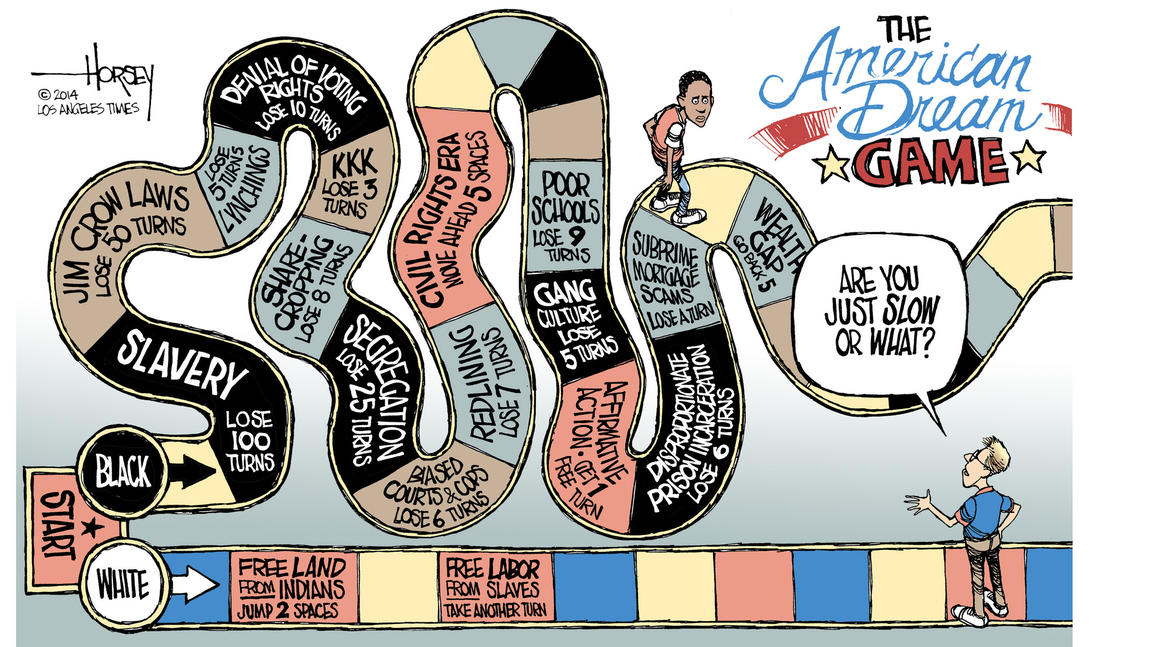
We bristle at the idea that a black person should get help that we never received. I worked hard to get to where I am today. Yes you did. But so did your parents and grandparents and great-grandparents, many of whom benefited by ousting Native Americans, by enjoying the benefits of free slave labor or milking the lives of sharecroppers. None of that is personally your fault or mine (and we bristle at the idea), but we have privilege lifting us up, while the black community has centuries of weight holding them down even today.

This cartoon so simply illustrates the differences:

1150x647

It’s time we open our eyes to the realities. Today it’s not blatant Jim Crow laws, but hidden biases in our justice system that seek anything but justice. A white teenager caught with drugs made a simple mistake, boys will be boys and they’re given a slap on the wrist. Black teen drug offenders are thugs and gangbangers. They get criminal records.

We villainize  criminals today, forgetting that Jesus Christ was a criminal, falsely accused and executed by the state. While hanging on the cross with thieves and robbers on either side, he turned and forgave the criminal.

When a black man is shot and killed by the police, we pull up every wrong the black man has ever done. We pull up his criminal record, the bad things he said, the questionable photos on social media. The forgiveness that is supposed to be at the very heart of our Christian faith goes out the window as we justify why this man deserved to be killed. He said bad things, once upon a time, so it’s OK for the police to shoot him. He robbed a store, so the death penalty is OK. Innocent until shot by police and proven guilty by a jury of sensational media. But he broke the law, so he had it coming.

It doesn’t matter if that black man was 12 years old.

It doesn’t matter if that black man was innocent.

Forgiveness does not apply because that black man was a bad man.

Not only was Jesus Christ a criminal, but so was Martin Luther King Jr. He sat in jail more than 30 times. The FBI had him under surveillance. They were more worried about this black man protesting and marching across the south than they were the KKK who were bombing and murdering across the south.

This is where we are today. We have sanitized—dare I say whitewashed—the civil rights movement to make it safe and comfortable and convince ourselves that we arrived at the mountaintop a long time ago. That way we don’t have to look around at the injustices piling up at our feet. We can ignore them and keep on walking.

We can decry the protesters who block freeways and clog shopping malls, dismissing them and labeling them as law breakers and criminals, ignoring that these same tactics were used 50 years ago in the civil rights movement. We herald these actions in history but condemn them in the present.

freewaysitin1964

We do not have equality today. We do not have justice today. We have not made it to the mountaintop.

There is still work to be done.

As we celebrate the life and work of Martin Luther King Jr. and the many other civil rights pioneers, let us not give in to the thinking that the work is done. Let’s find today’s civil rights pioneers, today’s strugglers and join with them.

What Now?

If, like me, you’re wondering what to do and want to be involved and know how you can help, then join me in listening.

Let’s read the powerful words of Martin Luther King Jr. His “Letter from a Birmingham Jail” is a good place to start.

But let’s not stop with powerful words written more than 50 years ago (as amazing as they are). Let’s listen to today’s leaders like Nekima Levy-Pounds, a local civil rights lawyer and law professor at St. Thomas. She’s one of 10 charged with organizing the #BlackLivesMatter protests at the Mall of America and charged with $25,000 in lost income and police overtime, in addition to other fines.

Let’s read books like The New Jim Crow: Mass Incarceration in the Age of Colorblindness by Michelle Alexander. Let’s attend MLK Day events and celebrate more than a sanitized legacy.

Let’s begin to understand how the promise of American has been limited to a select few, and that struggle and protest are the only way that promise has been opened to all. Keeping that promise is never easy or automatic. For justice to roll down, the people must rise up. Let’s do the work to ensure that all people truly are created equal and have the same advantages and opportunities.

Let’s make America the land of freedom and equality we claim it is.